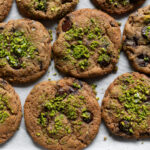
These pistachio chocolate chip cookies are big on pistachio (in both color and flavor!). And they feature the no-fail chocolate chip cookie dough recipe I’ve been perfecting for years. They’re always chewy in the center and crisp around the edges.
So how do you make chocolate chip cookies this green and pistachio-ey? It’s pretty simple!
Bright green color
- Their bright green color comes from a dusting of raw green pistachios.
- But if you don’t have any on hand, you can use whatever pistachios you’ve got. I’ve got substitution suggestions for just as much green, no matter what you have on hand.
Big pistachio flavor
- Roasted, salted pistachios are folded into the batter. These add a lovely roasted crunch, sort of like chocolate chip cookies with walnuts.
- I also include one funny ingredient that screams pistachio, while containing none: almond extract! Almond extract has been used to flavor pistachio ice cream for so long, it’s become the flavor we expect when presented with a bright green pistachio concoction. A little bit goes a long way in setting the right pistachio vibe.
Jump to the recipe if you’re ready to start baking, or read on for tips on getting the greenest, most flavorful pistachio chocolate chip cookies ever:


This post contains affiliate links (learn more).
How to make pistachio cookies green
The key to getting green cookies is to top them with finely ground raw green pistachios. But if you can’t find any, I’ve also got some tips for getting that green color using whatever you’ve got.
Finding raw green pistachios:
You’ll find the brightest-green pistachios in Iranian/Persian markets and occasionally Indian markets (or websites that stock Iranian/Persian ingredients). You’ll most reliably find them as slivered pistachios, but you’ll also sometimes find them as whole, blanched pistachios.
I have not personally vetted these, but these two Amazon options seem to be well-reviewed if you’re looking for a place to start: these Persian slivered pistachios or this jar of Italian chopped pistachios (affiliate links). These ones from Kalamala Persian Grocery also look good.
When I lived in Australia, I bought them at the Royal Nut Company, and in Hong Kong I buy them at Regency Spices.
What to look for:
- Your eyes are the ultimate judge here. Look for bright green pistachios like in the above photos.
- The word “raw” is a good sign, but they’re not always clearly labeled as such. And some so-called raw pistachios are not the greenest ever. But raw ones will always be greener than roasted ones.
Use them sparingly:
- These super green pistachios are more expensive than the usual ones, but that’s okay because they’re meant for decoration. When used more sparingly as a topping, they’ll add a ton of color and flavor without breaking the bank.
- Don’t use them too sparingly though. You don’t want to fold these into the dough, but you do want to sprinkle on enough that they are visible as the cookie spreads. Here’s how much I use, and what they look like after baking:


How and why to grind pistachios finely:
Bright green pistachios look their best finely ground, not coarsely chopped. Here’s how to do it:
- I prefer using a food processor. If you process them, make sure you don’t accidentally turn them into pistachio butter. Pulse for 3 seconds at a time, and stop as soon as they look like coarse sand. Do not just let the food processor run unattended.
- Finely chopping them by hand takes a lot more elbow grease than you might think, but it can be done. Just make sure you go over them enough times, until they are the consistency of coarse sand. It’s hard to over-do them with a knife and cutting board.
- I do this in a large batch and then store them in the freezer for any pistachio-flavored things I need to add a little extra pizzaz to.
What to do if you can’t find raw green pistachios:
No worries—there are other ways! I listed these from best to worst:
- Green food coloring with lackluster pistachios
- Place some regular-old pistachios in a food processor, drop in just 2 to 3 drops of food coloring along with 2 to 3 drops of water and start pulsing (this works even better if you can add the food coloring with the machine already running, but only if you move quickly enough so as not to overwork the pistachios). As they break down, the food coloring will start to coat them evenly and they will turn green.
- Careful not to overdo it with either the water or food coloring or they will bleed into the cookie dough. Start with less and add more as needed.
- Simply decorate with roasted, salted pistachios (same as the ones mixed in!):
- This is a perfectly fine option. They will not be super green, but the cookies will taste delicious. I recently made a batch this way for my friend’s book club, and there were absolutely no complaints. People loved them!
- Raw pepitas:
- Unfortunately pepitas’ green is not super bright, but they’re a bit greener than roasted pistachios and can add a tad more depth of color when combined with them.
- Use 1 part finely ground raw pepitas with 1 part finely ground pistachios.


How to make your cookies actually taste like pistachio:
Roasted, salted pistachios mixed in:
- For a toasty pistachio flavor, I love folding roasted salted pistachios into the cookies. If you’re a fan of roasted walnuts in chocolate chip cookies, you’ll love roasted pistachios here too.
- This is also a good way to avoid breaking the bank—roasted, salted pistachios are more reasonably priced than the super green, raw ones you might use on top.
Almond extract
- Even though it has no actual pistachio in it, almond extract reads as pistachio to most people. It’s so often used in pistachio ice cream, it’s become an expected flavor in anything pistachio-flavored.
- You should always avoid overusing almond extract, but that’s even more important here. Just 1/2 teaspoon will add enough flavor to highlight the natural flavor of the pistachios, without making these taste like almond cookies. In such a small amount, it acts as more of a background note.


Pistachio Chocolate Chip Cookies (the greenest)

A note on freezing: These bake beautifully after freezing in individual balls. Just shape into balls, smash slightly, decorate with toppings (make sure they adhere by patting them), place on a sheet pan, and freeze solid. Then move them to a freezer bag. Bake right from frozen, adding an extra 90 seconds to the bake time (or as needed).
- Yield: 30 large cookies
Ingredients
- 2 sticks [225g] cool room temperature butter
- 1 cup [200g] packed brown sugar
- 1 cup [200g] granulated sugar
- 1 tsp [5g] salt
- 2 large room temperature eggs
- 2 tsp [10g] vanilla extract
- 1/2 tsp almond extract (optional)
- 3 cups [390g] all purpose flour
- 3/4 tsp [4g] baking soda
- 1 1/4 tsp [5g] baking powder
- 1 2/3 cups [250g] chocolate chunks*¹
- 1 1/4 cups [125g] coarsely chopped roasted salted pistachios
- Sea salt for sprinkling*²
- Raw green pistachios,*³ ground finely for sprinkling
- Extra chocolate chunks or chips for decorating
Instructions
- Place the butter, brown sugar, granulated sugar, and salt in the bowl of a stand mixer fitted with the paddle attachment.*⁴ Beat together at medium-high speed until very light and fluffy, about 2 minutes.
- Add one egg to the butter/sugar mixer and beat at medium speed for about 15 seconds, just until incorporated. Add the other egg and continue mixing until very light and fluffy, about 30 more seconds. Scrape down the sides and bottom of the bowl with a flexible spatula. Add the vanilla extract and almond extract (if using) and beat for another 10 seconds, just to combine.
- Place the flour, baking soda, and baking powder in a fine mesh sieve or sifter. Sift directly into the stand mixer. Add the chocolate chunks and coarsely chopped pistachios, and mix everything together at low speed, just until it forms a uniform dough (about 15 to 30 seconds). Scrape the bottom of the bowl to make sure it is fully incorporated, but do not over-mix.
- Let the dough rest*⁵ in the fridge for 30 minutes, up to 48 hours.
- Preheat the oven to 350°F [180°C] while your dough chills, and line a few sheet pans with parchment.
- Roll the dough into 50g balls (a scant 1/4 cup, or a size 1.75 oz/size 24 disher).
- Space the balls evenly on the prepared sheet pans. Smash them slightly with the heel of your hand, just so toppings will not roll off. Add a few extra chocolate chunks or chips to the outside to make sure some are visible. Sprinkle with sea salt and pistachio bits.
- Bake for about 14 minutes*⁶, working in batches. They’re done when the edges are set and the centers are still very soft but not liquid. Slide the parchment onto the counter to cool.
Notes
*¹ You can use milk, semisweet, or dark—whatever kind of chocolate you prefer in your cookies. Pistachio classically goes with dark chocolate, but I think it’s equally good with milk chocolate. You can also use chocolate chips instead, but if you do, use 1 1/2 cups [250 g].
*² I love Maldon and other flaky sea salts for sprinkling on cookies, but you can use whatever sea salt you prefer. Fine sea salts dissolve as the cookies bake, so they don’t yield the best texture. And coarse salts are easy to accidentally over-use. Flaky sea salts are just right. But any will work.
*³ If you don’t have raw green pistachios, you can just use more roasted salted. Read more about them here. Your cookies will not look bright green like the ones in these photos in that case, but they’ll still turn out great. You can find raw green pistachios at Indian and Iranian/Persian markets. To grind them finely, chop by hand until they’re the texture of sand. Or do what I do and use a food processor, but be careful not to process them too long or they’ll turn into pistachio butter. Just grind them until they look like sand, and stop immediately.
*⁴ If you do not have a stand mixer, you can use a hand mixer with the egg beaters attached.
*⁵ It doesn’t matter whether they actually chill through—the key here is resting time. Thirty minutes makes a difference, but longer is even better. During resting, the flour and sugars hydrate, which results in cookies with a bakery-quality texture. If you skip this step, your cookies will turn out fine, but they won’t quite live up to their potential.
*⁶ 14 minutes will yield cookies that are crisp at the edges and chewy in the center after cooling. If you like your cookies well-done (crisp throughout with a snap), let them go for another minute or two. If you do not measure your dough balls carefully or if your oven is not well-calibrated, your bake time might be different, so keep an eye on the first batch.
Video note: If you don’t see the video for this post after scrolling up, please disable ad block and try reloading the page.