

If you’ve ever wanted to make hummus from dried chickpeas without much effort, welcome! This recipe is for anyone who loves the super-creamy end result of hummus made from dried chickpeas, but who doesn’t want to have to remember to soak beans overnight or buy an Instant Pot.
But why bother?
Growing up Middle Eastern in the 90s, I only ever found hummus at my family’s table. But these days, you can find it anywhere from airport kiosks to supermarkets. There’s really no need to ever make your own. But when it’s completely unnecessary to make something, that’s usually the most fun time to go all in on the from-scratch version. It’s easier than you might think (especially if you make this particular recipe). And it’s the only way to get hummus that’s this light and creamy. [May 2026 edit: If you’re very short on time, you can make a red lentil “hummus” that’s similar to this one, but which is ready in minutes].
Read on to learn more about the “hows” and “whys,” or jump to the recipe if you’re ready to hit the ground running.


How to make the best (and easiest) hummus using dried chickpeas
The big secret? Using baking soda. It saves you from two chores: soaking chickpeas overnight and peeling their husks away. Here’s why it works:
1) Skip the overnight soak:

When I cook chickpeas for salads or stews, I soak them overnight so they’ll keep their shape. But when you want your chickpeas to turn to mush, soaking isn’t worth it. And with hummus, the mushier, the better!
This strategy works because baking soda helps chickpeas cook more quickly. This will vary, depending on how old your chickpeas are as well as how large they are. Older, larger chickpeas will take longer. Mine cooked in 95 minutes.
2) Forget peeling:

For very smooth hummus, many recipes recommend peeling every chickpea by hand. Sure, it doesn’t take quite as long as you might think it would, but it is a bit of a pain.
But lucky for us, when you thoroughly cook chickpeas in a generous amount of baking soda, their skins slip away naturally. After about 30 minutes, skim them off with a spider skimmer or small mesh sieve, and you’re done.
Don’t worry about ensuring that all of the skins float to the top—the ones that you can’t skim away will blend right in super smoothly.
How to make your hummus taste like the real deal
If you want your hummus to taste like it was made in a Middle Eastern kitchen, there are several things you must keep in mind. These tips apply whether you’re starting with canned or dried chickpeas.
If you follow the recipe at the end of this post, you can’t go wrong. But here’s why each element matters, and some advice on what to watch for when searching for a good recipe:
1) Use enough lemon.
This is the number 1 thing most recipes get wrong. You must use enough lemon. If your hummus is not tangy, you’re just staring down a heap of mashed chickpeas. Avoid any recipe that calls for just a tablespoon or two (unless it yields a very small batch).
2) Use enough liquid in general.
The lemon juice does not just add acidity; it also adds moisture. But even with a generous amount of lemon juice, you still need to add quite a bit of water as well. Hummus should not be the texture of play-dough. It should be smooth and creamy.
In the recipe in this post, our chickpeas will absorb a lot of water during cooking, so you may not need to add more water. If your hummus is stodgy rather than creamy, add one tablespoon at a time.
3) Use enough tahini.
You’re probably noticing a trend here—”use enough ___”—and that’s because making a good batch of hummus is all about balance. Tahini gives hummus its silky texture. Too little tahini, and your hummus will be watery; too much, and it becomes a heavy paste. Just the right amount of tahini will bind with the water and lemon juice to create a perfectly velvety texture.
4) Use fresh garlic or garlic powder. They’re both great!
Many restaurants use garlic powder, which is my trick to getting hummus that tastes like it’s from my favorite shawarma place. But fresh garlic is classic and also works great. You can’t go wrong—use whichever you prefer.
5) Plate it with style (and plenty of olive oil)
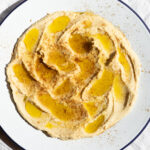
Hummus is not meant to be scooped from a big soup bowl. Spread it thinly on a deep plate or shallow bowl so that every bite gets some olive oil and spices. Swirl a spoon over the surface to make little indentations, pour on the oil, and finish with za’atar or paprika. This particular swirl pattern is what my family always does, and I love it:


Btw, if you make a batch of this hummus and are trying to think of ways to use it up, try my easiest-possible hummus bowls. In that recipe, I take every shortcut imaginable, so it’s a great way to put some really good from-scratch hummus to use without a lot of extra effort.
PrintHummus from Dried Chickpeas (the easy way)
- Yield: just under 2 cups (450g)*
Ingredients
- 1 cup [180g] dried chickpeas
- 2½ quarts [2.4 liters] water**
- 2 tsp [10g] baking soda
- 1 large garlic clove
- ¼ cup [60g] lemon juice
- ¼ cup [60g] well-stirred tahini
- ½ tsp salt
- Additional boiling water, as needed
To serve:
- Extra virgin olive oil
- Za’atar or paprika
Instructions
- Place the chickpeas, 2½ quarts water, and baking soda in a small stock pot or dutch oven.
- Bring to a boil over high heat. Once boiling, reduce heat to medium-low to maintain a simmer.
- After about 30 minutes of simmering, wave a spider skimmer or fine mesh sieve through the water over the surface of the chickpeas, and discard the husks that gather on it (repeat 2-3 times).*** Periodically add more boiling water as the level lowers.
- Simmer for a total of about 40 to 120 minutes (mine took 95 minutes), until chickpeas have cooked through completely. They will be very mushy.
- Drain your chickpeas over a fine mesh strainer. Let them cool for a few minutes.
- Place drained chickpeas in a food processor. Add a clove of garlic, lemon juice, tahini, and salt. Blend until completely smooth. If it is thick and stodgy, add a tablespoon of water at a time until it thins out to the right consistency.
- Spread hummus on a deep plate or shallow bowl. Make little dents and swirls on the surface with the back of a spoon. Drizzle with olive oil and sprinkle with za’tar or paprika.
Notes
* A note on doubling: To double this recipe, cook your chickpeas in a much larger stockpot or dutch oven. Double everything, including the water and baking soda.
** I recommend measuring the water, otherwise your baking soda solution may end up being way too strong or too weak.
*** Don’t worry about ensuring that all of the skins float to the top—the ones that you can’t skim away will blend right in super smoothly.
Video note: If you don’t see the video for this post after scrolling up, please disable ad block and try reloading the page.
This was my first attempt at making humus from scratch. This was way labor intensive. I’m going to try canned to see if there is a flavor difference. I may have missed these notes but I wished I would have known before starting. Having never made or used Tahini I didn’t know what the consistency should be. I opened a brand new jar and shook it. I now know what the body didn’t incorporate. This made the hummus loose. Also, there were no notes on how to fix thin or loose hummus.
Over all, good instruction, just needs to tweaking for us novices out there.
Hi Victoria, I’m sorry you didn’t have a great experience your first time making hummus! Canned is definitely a friendlier place to start if you’ve never made it before. I focused this post more on the issue of dried chickpeas and how to deal with those, so this post doesn’t focus as much on the other aspects of hummus.
Here are a few places to learn a bit more:
1) A post that gives more info on tahini (in the context of tahini sauce instead of hummus): https://cardamomandtea.com/319/lemon-tahini-sauce-roast-carrots-cauliflower/
2) My lemony hummus post, which is a much friendlier starting point: https://cardamomandtea.com/14/zesty-lemon-hummus/
One quick note: Definitely be sure to stir your tahini fully rather than just shaking it. It’s a lot like natural peanut butter with a layer of oil on top and thick layer of gritty paste on the bottom. It needs to be fully stirred every time you use it (and if you already used a lot of the oil from one jar, the ratio will be thrown off for future recipes—just mentioning to manage expectations there).
Also, you inspired me to add “well-stirred” to the ingredients list next to tahini. I’ve been cooking with it since I was a kid, so it would not have occurred to me to include that. But not everyone is as familiar with tahini as I am, so it’s a good note to add!
This is the best hummus recipe ever, hands down, thank you so much it’s absolutely delicious!
Aw I am so glad to hear it!! 😀
Wow, this hummus is absolutely delicious!!
I did soak the peas overnight before seeing you don’t have to, cooked them for 50 min. and the result is perfect 🙂
Thank you so much for sharing your recipe ♡
I’m so glad you liked it!! 😀
Hi! I just made this now, and me and my kiddos are enjoying it. We live in a small town in Mexico where the little round limes, like key limes, are ubiquitous and I used those instead–it came out perfectly delicious. One question–the skins didn’t all float to the top, they kind of shredded, and I kept trying to rinse them away from the the beans. Then I gave up and just blended like crazy, and it’s very smooth. But do y’all have success separating the skins? Thanks!
I’m so glad you’re enjoying it!! Limes would work great here—that sounds wonderful. It’s okay if the skins don’t all float to the top. The ones that do, you can skim away, and the rest of them will blend in just fine. I should add a note to the recipe not to stress about it. The baking soda helps them break down, even if you can’t skim them away completely.
Alrighty, added a note to the recipe (and notes before the recipe)! It’s really just about removing some of the skins for extra smoothness.
This turned out great. I left out the olive oil and paprika at the end when serving and added chopped roasted red peppers. Better then store bought. And easy to follow nice recipe. Hit in my house thanks for sharing.
I am so, so glad to hear that! 🥰
DO NOT FOLLOW THIS RECIPE! Boiling with that much baking soda completely disintegrated my chickpeas. No, I did not confuse teaspoons with tablespoons. It turns out we should not use more than 1/2 a teaspoon for every cup of chickpeas. Lesson learned the hard way :/
Hi John, I’m sorry you had a bad experience with it. The chickpeas are supposed to disintegrate quite a lot (the video shows how they are supposed to turn to complete mush) and are not supposed to stay whole. Did yours disintegrate so much that they could not be used for hummus? Like did they literally dissolve into the water? If so, that’s definitely not what was supposed to happen.
Also, annoying troubleshooting question: I don’t doubt you used the correct amount of baking soda, but did you also use the correct amount of water? It’s important that the water:baking soda ratio is correct. Using less water means the solution will be too strong.
(Just a quick note to say that I’ve just changed the note at the end of the recipe to specify that you *should* measure the water to make sure your solution is not too weak or too strong.)