• Skip to primary navigation
  • Skip to main content
  • Skip to primary sidebar
  • Skip to footer
Cardamom and Tea
  • Blog
  • Recipes
  • About
  • Cookbooks
    • Piecemeal
    • A Dish for All Seasons (my first cookbook)

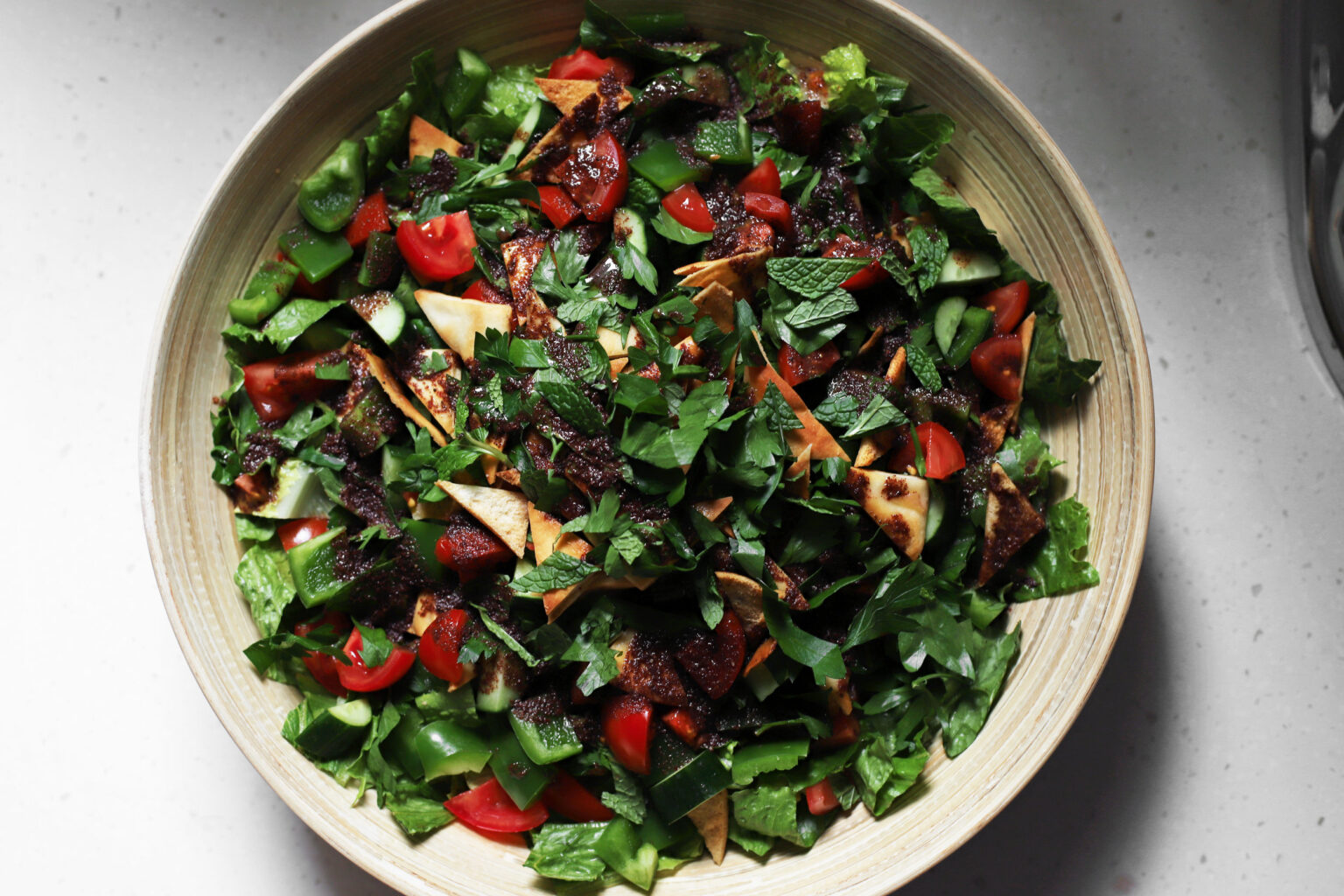
fattoush

March 21, 2019 by Kathryn Pauline 6 Comments

My mom taught me how to make fattoush long ago, and I posted about it back when I started blogging. But I was new to recipe writing, and hadn’t yet learned how to write streamlined instructions. I think there were like 4 paragraphs of footnotes, so I decided to give it a little makeover.

Hope you enjoy this one!

Things I love about this fattoush recipe:

  1. The dressing is mixed up on the side, which means that you have more flexibility in how you serve it. You can meal prep the whole thing on Sunday, and store the ingredients separately from the dressing. You can dress half of the salad to serve for dinner and then store the leftovers undressed. That way they’ll stay crisp for the next day. Or you can mix up the whole thing for a big dinner.
  2. I’ve included both US and metric measurements, so whether you want to eyeball it, use cups/tablespoons/teaspoons, or use a digital scale, this recipe has you covered.
  3. The pita gets baked, which is so much easier than frying or pan-toasting.

A quick note on ingredients:

Sumac is the only ingredient in this recipe that you might need to seek out. It’s available at Middle Eastern markets, and super easy to find online. While it might be tempting to seek out another recipe that suggests a substitution, I’m going to be real with you:

You absolutely need sumac to make decent fattoush.

You might find a recipe out there that says you can get away with substituting lemon zest or some other unrelated ingredient. But there’s really nothing out there that tastes remotely similar to sumac. The heart and soul of fattoush is in the pita chips and sumac. So while this salad might still be super delicious without the sumac, it would cease to be fattoush.

A little story about what fattoush means to me:

My grandparents had a cozy pre-war ranch house with a modest dining room, where we’d gather almost every weekend when I was a kid. A couple years after my grandfather passed away, my grandmother sold the house along with the dining room furniture. And as time goes on, the table grows bigger in my memory. When I think of it now, it fills the whole room, with just enough space for chairs to surround it. Every weekend, the big dining room table was laden with the food my grandmother cooked. And there was almost always a big bowl of fattoush in the center.

When we said there was going to be salad, we almost always meant this salad.

Print

fattoush

Print Recipe

5 Stars 4 Stars 3 Stars 2 Stars 1 Star

No reviews

  • Total Time: 25 minutes
  • Yield: 10 side servings

Ingredients

  • 2 medium pitas, cut into bite-sized triangles (140 grams)
  • 1 tablespoon neutral oil (14 grams)
  • 3 tablespoons sumac (25 grams)
  • 1/4 cup lemon juice (61 grams, from about 2 lemons)
  • 1/4 cup extra virgin olive oil (55 grams)
  • 1/4 teaspoon salt, or to taste
  • 1/2 teaspoon freshly ground black pepper
  • 1 medium head of romaine, chopped (375 grams)
  • 5 roma tomatoes, chopped (325 grams)
  • 4 Persian cucumbers, chopped (325 grams)
  • 1 large or 2 very small green bell peppers, chopped (170 grams after seeding)
  • 1 1/4 loosely-packed cups coarsely chopped mint leaves (15 grams)
  • 2 loosely-packed cups coarsely chopped parsley leaves (20 grams)
  • 1/2 to 2/3 cup chopped green onions (35 grams)

Instructions

  1. Preheat the oven to 350° F convection.*
  2. Coat the pita triangles evenly in 1 tablespoon of neutral oil. Spread evenly on a sheet pan, salt to taste, and bake until golden brown (about 10 to 14 minutes, depending on the thickness of the pita).
  3. Combine the sumac, lemon juice, extra virgin olive oil, salt, and pepper. Whisk, and set aside.
  4. Spread out the chopped romaine in the bottom of a large salad bowl. Top with the tomatoes, cucumbers, green pepper, mint, parsley, and green onions. When you’re ready to serve, whisk the dressing, top the salad with the dressing and pita chips, and toss everything together.

Notes

* If you don’t have convection, no worries—it just might take a little longer for them to toast, and you might need to rotate the pan once halfway through to make sure they’re browning evenly.

Storage

To store for less than a day: Make sure your herbs and veggies are well-dried before chopping with a sharp knife. Refrigerate the veggies and herbs in one sealed container, and the dressing in another. Store the toasted pita chips in a sealed container at room temperature once they’ve cooled down.

To store for a few days/for meal prep: Store as described above, but also refrigerate the herbs and green onions in another separate container, lined with a slightly damp paper towel (and seriously make sure you dry them well before chopping).

find us on instagram and let us know what you made!

Filed Under: dairy free, dinner, every recipe, family recipes, lunch, salads, vegan, vegetarian, weeknight Tagged With: cucumber, fattoush, greens, herbs, lemon, middle eastern, mint, parsley, peppers, pita, sumac, summer, tomato

kubba hamuth

March 7, 2019 by Kathryn Pauline 6 Comments

(Jump to the kubba hamuth recipe.)

I recently had a great conversation with my friend Tony about community-centered cooking. He’s preparing for an exciting upcoming project on Syrian food and community traditions. And we talked about a dolma project I’m working on. The two subjects aren’t entirely unrelated, or as Tony put it:

“If you’re sitting down rolling dolmas with your neighbors and family, you’re bound to connect and share very intimate details, because you have all the time in the world. And that’s so beautiful.”

We covered so much ground, and whenever the topic would shift, Tony would preface it by saying, “So, I don’t know if you want to fall down this rabbit hole, but…”

And here’s the thing about me: I love falling down rabbit holes. I’m currently falling down a dolma rabbit hole right now. But I think the next one I want to fall down is kubba. Because from where I stand, I have a lot to learn.

intro to kubba / kibbeh

I mean, growing up Middle Eastern American, I know a bit about kibbeh/kubba. In case you’re not already familiar, kubba is a meat and grain dumpling. There are a ton of different varieties. Some are named after the towns they’re from, and others after the style in which they’re made. While most are dumplings, some kibbeh are baked in a tray or eaten tartare/sashimi style.

My family is Assyrian from Iraq and Syria, and we have our family specialties. My Syrian family makes kbeibat and kibbeh bil sanieh. And my Iraqi family makes kubba Halab and sometimes also kubba hamuth. But I haven’t experienced all that much outside of these.

what should this recipe be called, anyway?

So when I sat down to do a little research for this blog post, I realized that what I’ve been calling kubba hamuth is actually very different than most recipes out there. Most of them (e.g., Philip Juma’s and MidEast Chef’s) use rice or rice flour instead of wheat or bulgur. The only other recipe I found that uses bulgur is Julian’s from Assyrian Dishes. She also adds greens, in her case swiss chard, which I highly recommend trying. I spoke with Hilda Sterner, whose kubba are made with rice, and she said that she would personally call my stew kubba pirdah, but that she also knows of a version that is made partly with cream of wheat.

Kubba hamuth basically means “sour kubba,” referring to the lemony tomato stew it’s simmered in. So the most crucial thing is that it’s tangy. And while I’m tempted to spend all week obsessively researching it, I’m going to have to wait a while to fall down this particular rabbit hole. I’m looking forward to learning more about the nuances and regional variations of all the different kinds, whether fried, boiled, stewed, or baked in a pan.

But for now, while I’m busy tilting at other windmills, I’ll just leave you guys with my recipe for kubba hamuth (…or something!). This is definitely the kind of recipe that’s fun to cook as a family. So I hope you enjoy it in good company.

Print

kubba hamuth

Print Recipe

5 Stars 4 Stars 3 Stars 2 Stars 1 Star

No reviews

  • Prep Time: 1 hour 15 minutes
  • Total Time: 2 hours
  • Yield: 9 servings (about 55 kubba)

Ingredients

for the kubba shell:

  • 1 cup extra fine bulgur #1 (200 grams)
  • 1 pound lean ground beef (454 grams)
  • 1 teaspoon baharat
  • 1 teaspoon salt

for the kubba filling:

  • 1 pound lean ground beef (454 grams)
  • 1/4 of 1 onion, finely minced (45 grams)
  • 1/2 cup finely minced parsley (30 grams)
  • 1 teaspoon baharat
  • 3/4 teaspoon salt
  • 1 tablespoon softened butter (14 grams)*

for the stew:

  • 3 tablespoons clarified butter or olive oil (43 grams)
  • 3/4 of 1 onion (135 grams)
  • 2 jalapeños, pith removed and minced (50 grams)
  • 1/2 teaspoon baharat
  • Two 14.5-ounce cans diced tomatoes (Two 400-gram cans)
  • 3 1/2 cups stock
  • Salt to taste
  • 4 packed cups torn or coarsely chopped dark leafy greens, like kale or spinach (100 grams)
  • 3 to 4 tablespoons lemon juice (to taste)

Instructions

  1. Make the kubba shell: Soak the bulgur in a few inches of cold water for 15 minutes, then strain it through a fine mesh sieve, wringing it out with the back of a spoon for a few seconds to get rid of excess water.
  2. Combine the strained bulgur, ground beef, baharat, and salt in a food processor, and blend together for 3 minutes, until it forms a dough. The bulgur will still be a bit grainy, but it will break down slightly.
  3. Make the kubba filling: Hand-mix the ground beef, minced onion, parsley, baharat, salt, and butter, just until combined.
  4. Stuff the kubba: Wet your hands as you work to keep things from sticking. Take a level tablespoon of the kubba shell, roll it into a ball, and flatten the ball out in the palm of your hand. Take a shy tablespoon of filling, place it in the center of the flattened shell, and wrap the sides around it until it makes a sphere. Roll the sphere in your hands to smooth it. Repeat, and pace yourself as you work, so you don’t run out of the shell or filling.**
  5. Make the stew: In a stockpot or large dutch oven, place the butter or oil over medium heat for a couple minutes. Once the butter melts, add the onion and cook for about 6 minutes, stirring every minute or two, until they’re a little golden.
  6. Add the jalapeños to the stockpot, and cook for 3 minutes to soften them a little.
  7. Add the baharat, give everything a stir, and then add the diced tomatoes and stock, and season to taste with salt. Bring it to a simmer over high heat, and then add the kubba one by one, slightly flattening each ball into a disc between your palms right before you add them. Allow about 30 seconds for everything to come back up to a simmer, then cover and reduce heat to medium-low.
  8. Cook covered for 10 minutes, then gently stir everything, cover and cook for 10 more minutes.
  9. After 20 minutes total, remove from heat, add the greens,*** give everything a gentle stir, and then add the lemon juice. The greens will take about 2 minutes to cook with the residual heat. Give it a final stir right before serving.

Notes

* You can make the filling with a fattier ground beef, but I developed the recipe this way so that you won’t have to buy 2 different kinds. But if you have 1 pound lean meat and 1 pound higher fat meat, feel free to skip the butter.

** This recipe has the right ratio of filling to shell, but no worries if you have some leftover at the end. Simply make a few small meatballs with the leftover filling (or the leftover shell), and throw them right in with everything else.

*** Letting the greens coast will help it stay green instead of turning gray, but if you’re making this ahead for guests, you might want to add the greens at the last second, because it will continue to cook as it cools down. Everything else can be made ahead of time, reheated later, and the greens added at the last minute. If you’re just making this for yourself and your family, it keeps great as is, and the leftovers will be delicious. Kale in particular isn’t traditional here, but it’s fairly traditional to add some greens or other veggies to the stew, and kale is just what I had handy when recipe developing, so feel free to add your favorite veggie instead.

find us on instagram and let us know what you made!

Filed Under: dinner, every recipe, family recipes, lunch, main courses, soups and stews Tagged With: beef, greens, lemon, middle eastern, tomato, winter

  • « Go to Previous Page
  • Page 1
  • Interim pages omitted …
  • Page 97
  • Page 98
  • Page 99
  • Page 100
  • Page 101
  • Interim pages omitted …
  • Page 183
  • Go to Next Page »

Primary Sidebar

Kathryn Pauline smiling

Welcome! I’m Kathryn Pauline, cookbook author, recipe developer, and photographer.

Footer

read our privacy policy

© 2017 - 2026 Kathryn Pauline