• Skip to primary navigation
  • Skip to main content
  • Skip to primary sidebar
  • Skip to footer
Cardamom and Tea
  • Blog
  • Recipes
  • About
  • Cookbooks
    • Piecemeal
    • A Dish for All Seasons (my first cookbook)

chicken kebabs (easy and flexible)

May 18, 2025 by Kathryn Pauline Leave a Comment

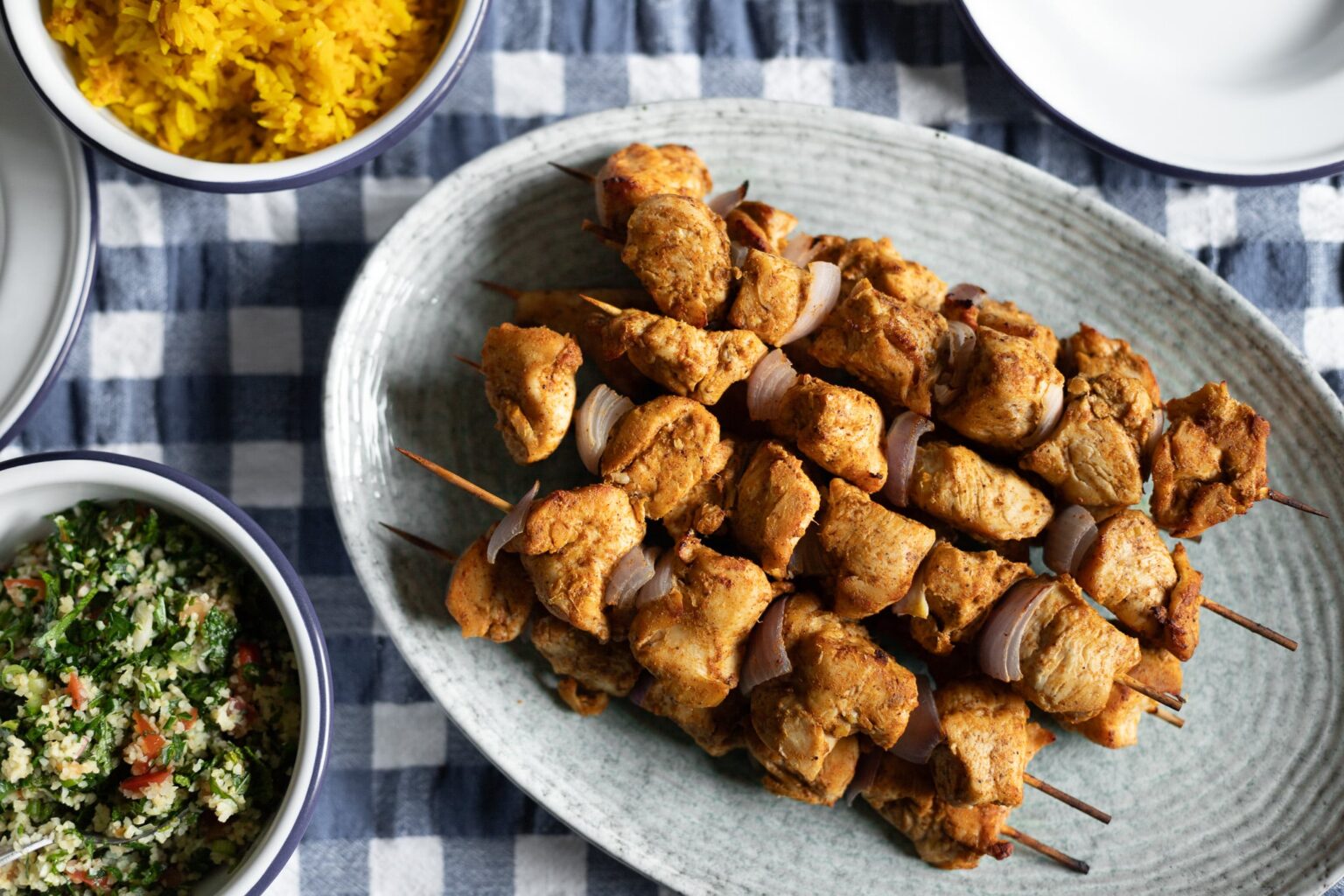
chicken kebabs on a blue gingham tablecloth

This is the most flexible recipe for chicken kebabs you’ll ever find. Make it your own with whatever you’ve got on hand:

  • Use breasts or thighs
  • Use a grill or oven (or even a fire pit!)
  • Let it marinate or skip right to cooking with 0 wait time
  • Use any spices
  • Make it dairy free

In this post, I’m going to walk through each of these customizations, or you can jump to the recipe.

chicken kebabs on a blue gingham tablecloth

How to keep your chicken kebabs juicy (no matter the cut or cooking method)

This recipe for chicken kebabs is super forgiving, and that’s because of the important first step: salting the chicken. Salting it right at the beginning is the key to juicy chicken, whether you’re using breast meat, thigh meat, and whether you’ve got a super hot gas grill or a pretty ho-hum oven broiler. You can even roast them over an open fire.

This salting step is technically called “dry brining,” but it’s as simple as giving your chicken a moment to absorb some salt. With dry brining, even if you go a little bit above the ideal doneness temperature, or even if you don’t have a thermometer in the first place—there’s a lot more wiggle room.

Why you don’t need to let chicken kebabs marinate overnight

Let’s talk about one of the most overrated cooking techniques out there: marinating meat overnight.

Here’s the thing: soaking meat in a zippy marinade? It’s mostly just a surface-level improvement (literally!). Flavors in marinades don’t actually make it past the outer layer of meat. So while your chicken might smell incredible in the bowl, once it hits the grill, most of that marinade drips right off. Whatever’s left behind in the bowl? Lost forever.

That’s why I prefer a different approach. Rather than letting your kebabs sit around in a marinade that may never make it past the surface, go with a punchy, clingy coating—something that sticks around and builds flavor as it cooks.

It’s faster, tasty, and (best of all) it skips the overnight wait.

One caveat: Salt does make a difference, because it can actually chance the texture of the meat. But when your chicken pieces are small (like the ones in this recipe), they don’t need a whole night to get the benefits. Salt early in the cooking process, and you’ll get tender, juicy results without all the waiting around.

All that said, if you want to prep your kebabs the night before, go for it. There’s no harm in letting them rest in the fridge overnight. It just doesn’t need to take that long.

Other ingredient substitutions

You can use pretty much any warm spice blend you have on hand, and you don’t need to use yogurt. If you’re fully omitting the yogurt, you’ll need to scale back on the lemon to make sure the spices don’t get washed away. Add just enough lemon to make a thick paste with the spices.

Step-by-step chicken kebab instructions

Cut the chicken into 1 1/2 inch [4 cm] cubes and place in a medium mixing bowl.

Sprinkle the chicken evenly with 1 1/4 tsp [7 g] salt.*** Let it sit for 5 minutes before proceeding. Salting it first will help it stay juicy. If you plan to cook them right away, preheat your oven’s broiler to its highest setting or your grill to medium-high (brush your grill grates with a thin layer of oil first).

Top the chicken with the yogurt, paprika, spice blend, garlic, and lemon zest and juice. Mix together until coated evenly.

Skewer the chicken, alternating each piece of chicken with a piece of onion. If you’re making them ahead, cover and refrigerate overnight and preheat your broiler or grill the next day. If you’re making them now, proceed.

For grilling: Place on the grill, cover, and cook for about 10-15 minutes for breasts (15-18 minutes for thighs), flipping once halfway through. They’re ready to flip once the first side is caramelized and a little charred. If they caramelize too quickly, turn the heat down.

For broiling: Place on a aluminum foil-lined aluminum sheet pan. Place under your oven’s broiler and cook for about 10-17 minutes for breasts (15-20 minutes for thighs), flipping once halfway through. If they caramelize too quickly, turn the heat down.

The chicken is done once it reaches an internal temperature of 165°F [74°C] for breasts, 185°F [85°C] for thighs.

Print

chicken kebabs (easy and flexible)

Print Recipe

5 Stars 4 Stars 3 Stars 2 Stars 1 Star

No reviews

Ingredients

  • 2.5 lb [1.1 kg] boneless chicken breasts, thighs, or tenderloins
  • Salt
  • 1/3 cup [80g] Greek yogurt*
  • 2 Tbsp [12g] sweet paprika
  • 2 tsp [4g] baharat, garam masala, or other spice blend**
  • 1/2 tsp ground black pepper
  • 1/2 tsp garlic powder or 2 crushed garlic cloves
  • The zest of 1 lemon
  • 1 Tbsp lemon juice
  • 1 red onion, diced very coarsely (optional)

Instructions

  1. Cut the chicken into 1 1/2 inch [4 cm] cubes and place in a medium mixing bowl. Coat the chicken evenly with 1 1/4 tsp [7 g] salt.*** Let it sit for 5 minutes before proceeding. Salting it first will help it stay juicy.
  2. If you plan to cook them right away, preheat your oven’s broiler to its highest setting or your grill to medium-high (brush your grill grates with a thin layer of oil first).
  3. Top the chicken with the yogurt, paprika, spice blend, garlic, and lemon zest and juice. Mix together until coated evenly.
  4. Skewer the chicken, alternating each piece of chicken with a piece of onion.
  5. If you’re making them ahead, cover and refrigerate overnight and preheat your broiler or grill the next day. If you’re making them now, proceed.
  6. For grilling: Place on the grill, cover, and cook for about 10-15 minutes for breasts (15-18 minutes for thighs), flipping once halfway through. They’re ready to flip once the first side is caramelized and a little charred. If they caramelize too quickly, turn the heat down.
    For broiling: Place on a aluminum foil-lined aluminum sheet pan. Place under your oven’s broiler and cook for about 10-17 minutes for breasts (15-20 minutes for thighs), flipping once halfway through. If they caramelize too quickly, turn the heat down.
  7. The chicken is done once it reaches an internal temperature of 165°F [74°C] for breasts, 185°F [85°C] for thighs.

Notes

* Omit the yogurt if you want to make this dairy free (and add just enough lemon juice to make a paste with the spices that will cling to the chicken without washing off—you may need more or less than is listed in the recipe), or substitute a plain, unsweetened dairy free yogurt.

** You can use any savory spice blend. If you don’t have a spice blend on hand, you can use a combination of cumin, black pepper, and a tiny bit of cardamom or cinnamon.

*** If you need to cut back on salt for health or personal preference, feel free to. Salt helps chicken stay juicy, so you will need to be more careful not to overcook it if you use less.

Video note: You can find the video in the introduction to this blog post. If you don’t see it after scrolling up, please disable ad block and reload the page.

find us on instagram and let us know what you made!

Filed Under: dairy free, dinner, every recipe, gluten free, lunch, main courses, weeknight Tagged With: baharat, chicken, garlic, grilling, lemon, middle eastern, yogurt

Victoria sponge cake (my signature bake)

April 27, 2025 by Kathryn Pauline 6 Comments

victoria sponge cake with powdered sugar on top (viewed from the side)

Of the 500+ recipes I have ever written, this Victoria sponge cake (AKA Victoria sandwich cake) is the one I am proudest of—and I don’t say that lightly.

The crumb is extremely tender, almost like a buttermilk biscuit or very delicate scone. It’s fluffy and springy—buttery, yet light. And when I bake it for friends and family, no one can resist a second slice.

If you’re going to master just one cake recipe, I humbly present this one. And even if you already have a few dozen cake recipes under your belt, you’re in for a treat.

Jump to the recipe to get to baking, or read on for a bit about why this one has earned a special place in my kitchen. Here’s why I love it, and what we’re gonna cover in this post:

  • You can get creative with the filling! (Fun!)
  • It uses a special technique called reverse-creaming, which is way easier than it sounds.
  • That method is easiest to explain visually, so I made a quick video and step-by-step instructions.
victoria sponge cake being layered, rugelach before rolling up, and a whipped cream fool
victoria sponge cake being dusted by powdered sugar

How to get creative with the filling

Victoria sponge cake is also known as Victoria sandwich cake, because it’s traditionally filled with strawberry jam and whipped cream. But there are so many ways you can get creative with it.

Filling ingredient possibilities:

  • Add fresh strawberries or skip the fresh fruit entirely.
  • Opt for a store-bought jam, preserves, or even a homemade compote.
  • Whip the cream to medium-firm peaks and dollop it, or go a skosh further to stiff peaks and then pipe it with a fluted tip.
  • Go wild and use a totally different jam flavor/sprinkle on another kind of fresh berry
  • You can even opt for a lemon or passion fruit curd or lemon curd instead of the jam.

What order to layer the ingredients:

You must layer your cake strategically, depending on the ingredients you choose. Here is the key:

Start with the firmest spread, end with the softest spread, and put the fresh berries in the middle (if you are using them).

So if you’re using a super set jam that’s right from a store-bought jar, you will likely need to start with that and end with the whipped cream. If you’re using a soft homemade compote, you should start with the whipped cream and end with the compote. Likewise with any kind of curd, which will be much softer than whipped cream. If you’re not using fresh berries, that’s cool. But if you are using fresh berries, just make sure they go in between the two spreads.

And be prepared for a bit of the filling to pop out of the side, especially if your fillings are particularly soft—that’s just part of the charm!

I love this recipe so much, I even made this wonky little painting of it!

Why is this Victoria sponge cake special? Reverse-creaming!

What is reverse-creaming?

Rose Levy Beranbaum invented this method. It might sound fancy, but it’s actually even easier than the usual method. Instead of creaming the butter and sugar together first, you cream the butter and sugar along with the flour and other dry ingredients. Then you add the wet ingredients.

Why does reverse-creaming work?

Cake’s natural enemy is gluten. Too much gluten activation will make a cake turn out dry, chewy, and dense instead of moist, fluffy, and light.

In a typical cake recipe, you can avoid this by not over-mixing your batter. Mix the wet ingredients and the dry ingredients separately, and then bring them together with as few passes as possible.

But for an even more tender crumb, we reverse-cream. By working the butter and flour together, all those flour bits get coated in fat, which creates a water-resistant seal. Since the flour has been waterproofed, it can’t quickly absorb all the moisture from the eggs and milk. And since gluten needs moisture to form, this waterproofed batter can’t form gluten as easily.

(Allergy note: This does not mean this is a gluten-free cake or even a low-gluten cake. It’s just aesthetically not glutinous. It still contains gluten.)

Step-by-step instructions

greasing 2 pans

Preheat the oven to 350°F [180°C]. Butter and line two 9 in [23 cm] cake pans with parchment.

adding butter to stand mixer

In the bowl of a stand mixer fitted with the paddle, combine the flour, sugar, baking powder, and salt on low speed to combine.

the texture of the butter/flour mixture: it looks like sand

Add the butter and beat together until it looks like fine sand, 1½ to 2 minutes (start on low speed, then increase to medium).

cracking an egg over the flour/butter mixture

With the mixer running* on medium speed, add 1 egg every 5 seconds or so.

slowly streaming milk into the stand mixer while it runs

Drizzle in the milk. Be careful not to overmix—do not leave the mixer running while you’re not adding anything.

scraping the bottom of the stand mixer bowl to fully mix

Scrape the bottom of the bowl with a spatula to make sure it’s fully incorporated.

pouring batter into prepared pans

Pour into the prepared pans. Spread evenly. Bake for about 17 minutes, until a toothpick comes out clean. Cool on a wire rack.

adding icing sugar to whipping cream in a bowl

Place the powdered sugar and heavy cream in the bowl of a stand mixer fitted with the whisk. Mix on medium for about 2½ minutes.

showing medium-firm peaks (they droop, but don't fall down)

As soon as it reaches medium-stiff peaks, stop whipping. Store in the fridge until you need it.

spreading jam over one half of the cake

To assemble the cake, place one completely cooled layer on a plate or cake stand.

spreading whipped cream over the jam

Top with jam and whipped cream (see the recipe below for more info on what order to place your layers).

topping the filling layer with another cake layer

Top with the other cooled layer. Dust with powdered sugar and enjoy!

Print

Victoria sponge cake (my signature bake)

victoria sponge cake being dusted by powdered sugar
Print Recipe

5 Stars 4 Stars 3 Stars 2 Stars 1 Star

5 from 1 review

Ingredients

For the cake:

  • 1½ cups [195 g] all-purpose flour
  • 1 cup [200 g] granulated sugar
  • 1½ tsp baking powder
  • ½ tsp salt
  • 8 Tbsp [115 g] unsalted butter, at room temperature, plus more for greasing the pans
  • 4 large eggs
  • ½ cup [120 g] milk, at room temperature

For the whipped cream:

  • 3½ Tbsp [25 g] powdered sugar, plus more for dusting
  • ½ cup [115 g] heavy whipping cream, cold

To assemble:

  • Heaped ⅓ cup [140 g] strawberry preserves, jam, or low-moisture homemade compote
  • Optional: sliced strawberries

Instructions

  1. To make the cake, preheat the oven to 350°F [180°C]. Butter and line two 9 in [23 cm] cake pans with parchment rounds.
  2. In the bowl of a stand mixer fitted with the paddle attachment, combine the flour, granulated sugar, baking powder, and salt on low speed just to combine. Add the butter and beat together until it looks like fine sand, 1½ to 2 minutes (start on low speed, then increase the speed to medium).
  3. With the mixer running* on medium speed, add 1 egg every 5 seconds or so, then drizzle in the milk. Be careful not to overmix—do not leave the mixer running while you’re not adding anything. Scrape the bottom of the bowl with a spatula to make sure it’s fully incorporated.
  4. Pour the batter into the prepared pans, dividing it equally into 2 thin layers. Spread the batter evenly.
  5. Bake for about 17 minutes, until a toothpick inserted in the center comes out clean. Cool the cake layers on a wire rack.
  6. To make the whipped cream, place the powdered sugar and heavy cream in the bowl of a stand mixer fitted with the whisk attachment. Mix on medium speed for about 2½ minutes. As soon as it reaches medium-stiff peaks, stop whipping. Store in the fridge until you need it.
  7. To assemble the cake, place one completely cooled cake layer on a plate or cake stand. Top with the preserves* or jam and spread out to the edges. Dollop the whipped cream evenly across the surface and spread out to the edges. Top with the other cooled cake layer.
  8. Dust with powdered sugar and serve immediately, or refrigerate for a couple hours. Leftover slices should be stored in the fridge, and will keep for 1 to 2 days, but it’s best served soon after assembling.

Notes

* Have your eggs ready to go in a liquid measuring cup, or add them with the mixer stopped if you’re cracking them directly into the bowl (so you don’t accidentally mix shell in).

** Layering order: If you’re using strawberries, they should always go in the middle. For the spreadable layers, you should end with whichever layer is softest and start with whichever layer is firmest. So if your whipped cream is firmer than your compote, start with the whipped cream. If you’re using a very set jam straight from the jar, start with the jam and then layer on the whipped cream.

Video note: You can find the video in the introduction to this blog post. If you don’t see it after scrolling up, please disable ad block and reload the page.

find us on instagram and let us know what you made!

Filed Under: every recipe, sweets, vegetarian Tagged With: berries, cakes, strawberry, whipped cream

  • « Go to Previous Page
  • Page 1
  • Interim pages omitted …
  • Page 43
  • Page 44
  • Page 45
  • Page 46
  • Page 47
  • Interim pages omitted …
  • Page 183
  • Go to Next Page »

Primary Sidebar

Kathryn Pauline smiling

Welcome! I’m Kathryn Pauline, cookbook author, recipe developer, and photographer.

Footer

read our privacy policy

© 2017 - 2026 Kathryn Pauline