• Skip to primary navigation
  • Skip to main content
  • Skip to primary sidebar
  • Skip to footer
Cardamom and Tea
  • Blog
  • Recipes
  • About
  • Cookbooks
    • Piecemeal
    • A Dish for All Seasons (my first cookbook)

Minestrone (with any vegetables)

July 25, 2025 by Kathryn Pauline Leave a Comment

minestrone

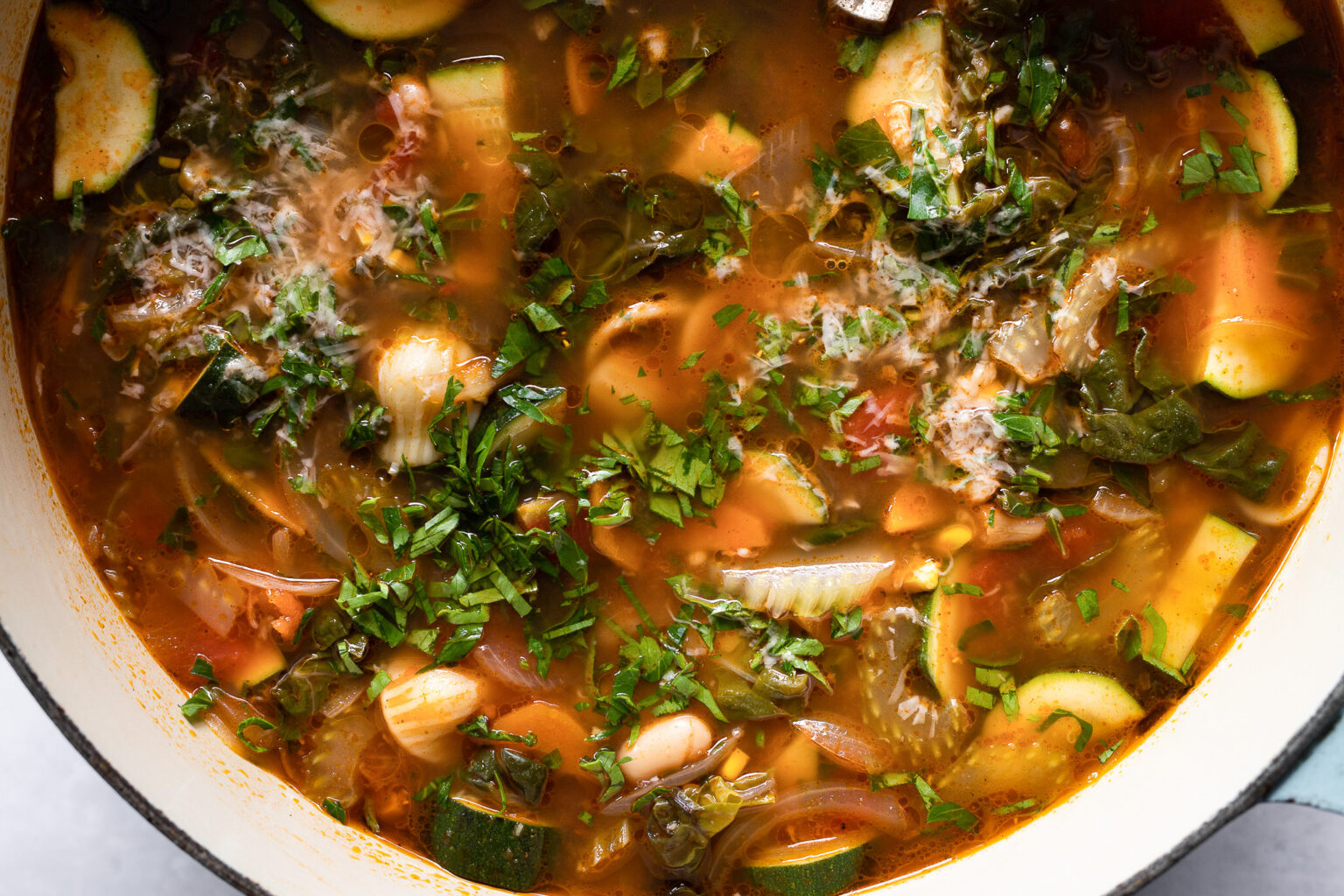
So you’ve got a fridge of half-forgotten vegetables, and no idea what to make for dinner? Minestrone to the rescue! This recipe doesn’t ask for perfection—it just asks what you’ve got in the fridge. A lonely half-a-zucchini? Toss it in. That bag of spinach you meant to add to omelettes all week (but ended up eating cereal instead)? Perfect. This minestrone is less of a recipe and more of a formula.

Jump to the recipe if you’re ready to go, or read on for lists of vegetables, a list of ingredients you can substitute, and some minspiration.

minestrone
minestrone

Veggies you can toss into this minestrone

You can truly use just about any vegetable you’d like, so don’t feel tethered to this list. That said, these veggies play particularly well in minestrone.

How to add vegetables: This is a true one-pot recipe—the pasta, veggies, and everything simmer together. But different ingredients have different cook times, so to keep everything from turning to mush, it’s important to group veggies into two categories: slow-cooking and quick-cooking. Start with the slow-cooking ones, then toss in the quick-cooking ones a minute or two before everything else is ready. And be sure to time it so the pasta finishes alongside the vegetables.

Don’t worry if this sounds like a lot to remember—the recipe takes you through it step-by-step.

Slow-cooking produce (7 to 10 minutes—add first)

Green bean segments
sliced bell pepper
mini okra
chopped thick Swiss chard stems
thinly sliced fennel
½ in [13 mm] diced winter squash, sweet potatoes, or parsnips
chopped kale or collards
½ in [13 mm] sliced potatoes
thinly sliced mushrooms
Quick-cooking produce (1 to 2 minutes—add last)

raw or grilled corn kernels
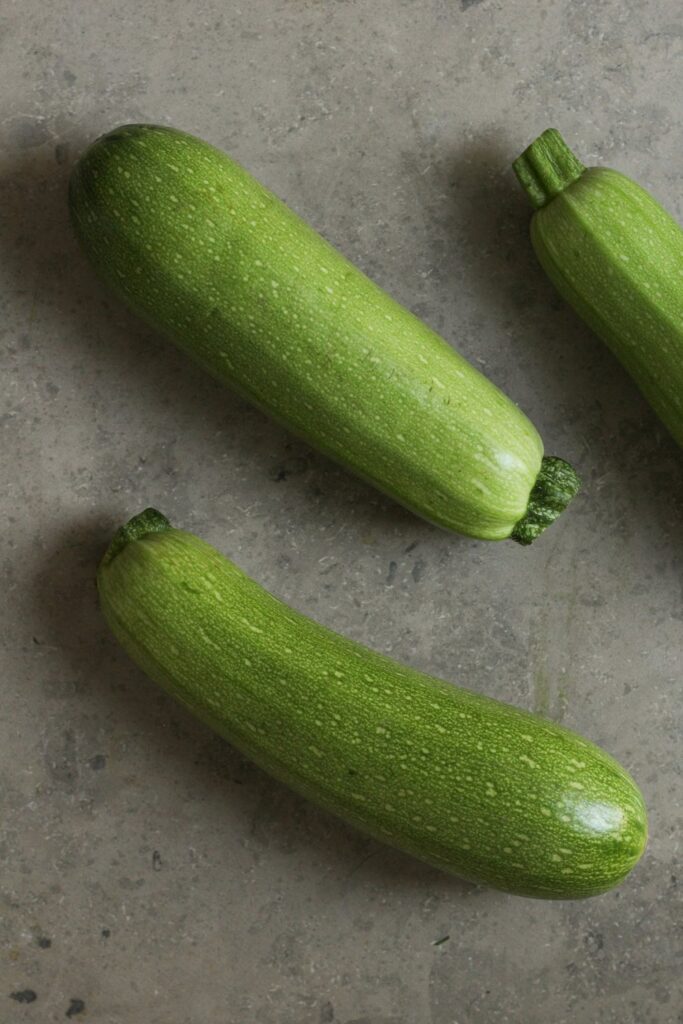
½ in [13 mm] diced zucchini or summer squash
chopped
swiss chard leaves
small cauliflower or broccoli florets
fresh spinach
peas
frozen corn, peas, or lima beans

Minestrone combinations I love

In the summer, I like Swiss chard, corn, and zucchini. In the fall and winter, I go with sweet potatoes, kale, and mushrooms. And I love peas, baby spinach, and potatoes for spring.

minestrone
minestrone

Ingredient substitutions

There are a few essential ingredients (onion, olive oil, garlic, lemon), but everything else is up in the air. If you go really far afield it might turn out to be less of a minestrone and more of a random vegetable soup. But if you do it thoughtfully, it’ll still be delicious!

  • Carrots and celery: If you don’t have carrots and celery on hand, you can play it by ear, depending on your other ingredients. They are usually the backbone of a soup, but you can easily leave these out if the other vegetables you’re adding carry a lot of aromatic flavor. For instance, if you’re adding fennel and bell peppers, you’ve probably got enough aromatic flavor there.
  • Vegetable stock: Any stock will work here, as long as it goes with your other flavors.
  • Red pepper flakes: You can substitute another dried hot pepper blend or omit entirely if you don’t want spice.
  • Diced tomatoes: If you’re making minestrone in the heart of tomato season, feel free to replace the can of diced tomatoes with an equal amount of chopped very ripe tomatoes (2 cups [400 g]).
  • Beans: Literally any beans will work here—just choose ones that go with the rest of your flavors.
  • Pasta: Use whatever little pasta you’ve got on hand. Or if you reeeally don’t feel like going to the grocery store, you could probably get away with using whatever pasta you have on hand. You just might need to break out the chopsticks if you go with something like spaghetti.
  • Parsley: Using something different from parsley will take this out of traditional minestrone territory, but cilantro, chives, or dill would also work here (as long as they go with your other ingredients, and as long as you like the flavor). You can also omit the parsley.
  • Parmesan is totally optional and can be omitted or replaced with another similar hard cheese (romano, asiago, etc.).
Print

Minestrone (with any vegetables)

minestrone
Print Recipe

5 Stars 4 Stars 3 Stars 2 Stars 1 Star

No reviews

Almost all of these ingredients can be substituted—see the notes above the recipe for more info.

Ingredients

  • 1 medium onion
  • 2 carrots
  • 3 stalks of celery
  • 2 tablespoons olive oil
  • 2 quarts vegetable stock
  • 2 Tbsp minced or pressed garlic cloves
  • 1 pinch of red pepper flakes
  • 14½ oz [410 g] can of diced tomatoes
  • 15 oz [420 g] can of cannellini or kidney beans, drained (or another bean)
  • 1¼ cups [100 g] of orecchiette or another small pasta
  • Up to 4 cups of vegetables (e.g., sliced zucchini, swiss chard, and corn)
  • For garnish: lemon wedges, chopped parsley (optional), and Parmesan (optional)

Instructions

  1. Sauté the onion, carrots, and celery in olive oil over medium heat until they soften (about 8 minutes).
  2. Once they soften, add the stock, garlic, red pepper flakes, and diced tomatoes and bring to a boil.
  3. Once it comes to a boil, add the beans and pasta and turn the heat down to medium-low to maintain a simmer. Set a timer for the length of time your pasta is supposed to take to reach al dente.
  4. Add your favorite vegetables to your soup in stages, so that they all finish cooking at the same time as the pasta. Use my list of produce to get a sense of how long different vegetables take to simmer. Add slow-cooking veggies when there’s 7-10 minutes left on the pasta, and add quick-cooking vegetables when there’s 1 or 2 minutes left on the pasta.
  5. Finish it off with fresh lemon juice, a big handful of chopped parsley, and a generous sprinkling of Parmesan at the table.

find us on instagram and let us know what you made!

Psst… by the way, I wrote a whole cookbook of adaptable recipes like this one. It’s called A Dish for All Seasons!

Check it out for adaptable base recipes + ideas for seasonal (and evergreen!) variations. It includes this adaptable minestrone + 4 additional seasonal soups that I love (summery corn chowder, lentil with carrots and squash, avgolemono, and vidalia French onion).
Filed Under: dinner, every recipe, lunch, soups and stews, vegan, vegetarian, weeknight

Chicken Curry

July 24, 2025 by Kathryn Pauline 6 Comments

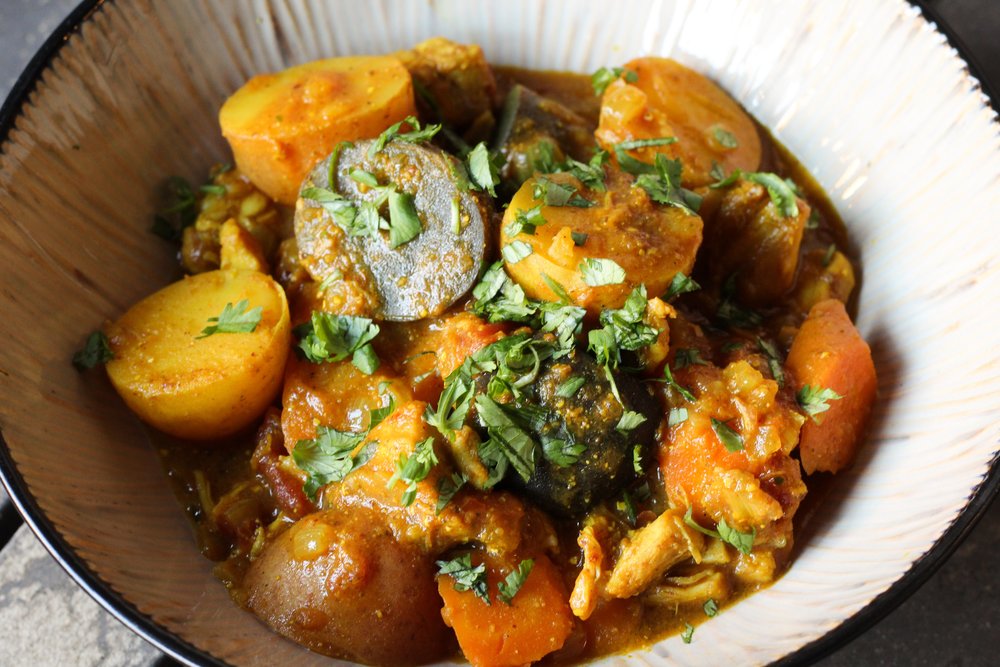
This chicken curry is an Assyrian-style stew my mom and grandmother have always made, and one my sister, brother, and I still cook today.

There are a lot of versions of chicken curry out there, and this one is pretty simple. The ingredients are straightforward—chicken, a few vegetables, and a blend of spices you can either buy or make yourself. I’ve got a recipe for yellow curry powder if you’re feeling adventurous.

But even with a simple recipe like this one, the flavor is anything but basic. The magic comes from layering the aromatics and giving the chicken curry time to simmer.

chicken curry

What kind of curry should I use for chicken curry?

One question I get a lot is about the curry powder. What kind should you use? And what is curry powder anyway?

What you should use: Supermarket yellow curry blends can be a bit all over the place. Some are mostly just turmeric, while some have more complexity. For this chicken curry recipe, you want to find something with a lot of fenugreek. My grandmother swears by “Madras curry powder,” which is very similar to the recipe I linked to above. You want to try to find something with turmeric and a decent amount of fenugreek. But even if all you can find it a random shaker of yellow curry powder from your local supermarket, that will work just fine.

What yellow curry powder is: Yellow curry powder shows up in a lot of Assyrian and Iraqi cooking. It’s not a traditional ingredient in the oldest sense, but it’s become a beloved part of our cooking. It’s just one of those staples we always have on hand. Curry powder itself has a winding global history, with ties to British colonial trade and South Asian cuisine. If you’re curious to dig deeper, writers like Sucharita Kanjilal, Naben Ruthnum, and Little Global Chefs offer thoughtful perspectives on that history.

chicken curry
Print

Chicken Curry

Print Recipe

5 Stars 4 Stars 3 Stars 2 Stars 1 Star

5 from 2 reviews

  • Prep Time: 25 minutes
  • Total Time: 50 to 60 minutes
  • Yield: 4 servings

Ingredients

  • 3 tablespoon cooking olive oil, divided into thirds
  • Salt to taste (about 1 teaspoon total)
  • 1 1/2 pounds boneless, skinless chicken thighs, cut into small pieces *
  • 1 small onion, diced
  • 3 tablespoons yellow curry powder
  • 1/4 teaspoon crushed red pepper flakes (or to taste)
  • 1 cup chicken stock or water
  • 14 1/2 ounce can diced tomatoes
  • 1 pound waxy potatoes, cut into large 3/4-inch chunks **
  • 7 ounces carrots, cut into large chunks
  • For garnish: 3 tablespoons chopped cilantro, or to taste
  • Serve with basmati rice

Instructions

  1. Heat a stock pot over high heat for 2 minutes. Add 1 tablespoon oil, swirl it around the pan to coat, and immediately add the chicken and salt to taste (about 1/4 to 3/4 teaspoon, depending on your preference).
  2. Sauté the chicken for about 10 to 14 minutes, scraping the chicken up and stirring every minute or two, until the liquids have evaporated, the chicken has turned golden-brown, and there are some brown bits on the bottom of the pan. Adjust the heat as necessary while you’re sautéing to make sure the chicken neither burns nor steams.
  3. Reduce the heat to medium-low, push the chicken to the outer edge of the stock pot, and add the onions to the center, followed by 1 tablespoon oil. Season with a pinch of salt.
  4. Cook the onions, stirring the center occasionally, until they have softened, about 4 minutes. Adjust the heat to prevent them from browning.
  5. Reduce heat to low, add the curry powder, red pepper flakes, and the final tablespoon of oil, and stir everything together for 1 minute.
  6. Add the stock or water to the pot, adjust heat to high, and immediately use a wooden spoon or spatula to scrape up the brown bits on the bottom of the stockpot.
  7. Add the can of tomatoes, potatoes, and carrots. Stir together, taste, and adjust the seasoning as necessary by adding more salt.
  8. Once it comes to a simmer, cover, reduce heat to low, and cook for 20 to 30 minutes, depending on the size of your vegetables. To test whether it’s done, take a potato out of the pot with a spoon and try cutting it in half. If it’s still crunchy, continue cooking, covered, testing every so often for doneness.
  9. Serve the chicken curry garnished with cilantro.

Notes

* If you’re using bone-in chicken thighs, this comes from about 3 1/4 pounds bone-in skin-on chicken thighs. Here’s a helpful video on deboning chicken thighs. If you’d prefer to use chicken breast instead of chicken thighs, sauté the chicken breast pieces over high heat for about 7 minutes, until they’re no longer pink inside, and remove them to a plate before adding the onions to the pot. Cook everything else separately according to the recipe, then add the chicken back in once the potatoes are done, and simmer everything for 2 to 3 minutes.

** You can use any combination of Yukon gold, Adirondack blue, new, red, or another similar potato (just don’t use russets, which will fall apart too much). If the potatoes are very small, you can just cut them in half.

Video note: If you don’t see the video for this post after scrolling up, please disable ad block and try reloading the page.

find us on instagram and let us know what you made!


2025 update: I edited this post (originally posted 2 Nov 2017) to have more relevant information before the recipe + to give a bit more historical and personal background on the recipe. I also added a video of the recipe.

Filed Under: dairy free, dinner, every recipe, family recipes, gluten free, lunch, main courses, soups and stews Tagged With: carrots, chicken, cilantro, curry powder, herbs, middle eastern, potatoes, spring, winter

  • « Go to Previous Page
  • Page 1
  • Interim pages omitted …
  • Page 29
  • Page 30
  • Page 31
  • Page 32
  • Page 33
  • Interim pages omitted …
  • Page 183
  • Go to Next Page »

Primary Sidebar

Kathryn Pauline smiling

Welcome! I’m Kathryn Pauline, cookbook author, recipe developer, and photographer.

Footer

read our privacy policy

© 2017 - 2026 Kathryn Pauline