• Skip to primary navigation
  • Skip to main content
  • Skip to primary sidebar
  • Skip to footer
Cardamom and Tea
  • Blog
  • Recipes
  • About
  • Cookbooks
    • Piecemeal
    • A Dish for All Seasons (my first cookbook)

fresh fava beans with butter and garlic (+ the easiest shelling technique)

April 4, 2018 by Kathryn Pauline 4 Comments

Fresh fava beans are finally having their moment! While dried and canned versions are always on the shelf, spring is the short-but-glorious window when you can find them fresh (although they’re also often available throughout the summer, while supplies last!).

I’ve been scooping up armfuls from my neighborhood market all week, and along the way, I’ve cracked the code on how to prep and enjoy these beauties.

Yes, they’ve got a bit of a diva reputation, but trust me—once you know what you’re doing, fresh fava beans are much less high-maintenance than they seem. They’re extremely easy to shell (read on for more). And they’re even easier to cook. Jump to the recipe if you’re ready to go, or read on for more. Or check out my ful medames recipe if you’re looking for a way to cook dried favas.
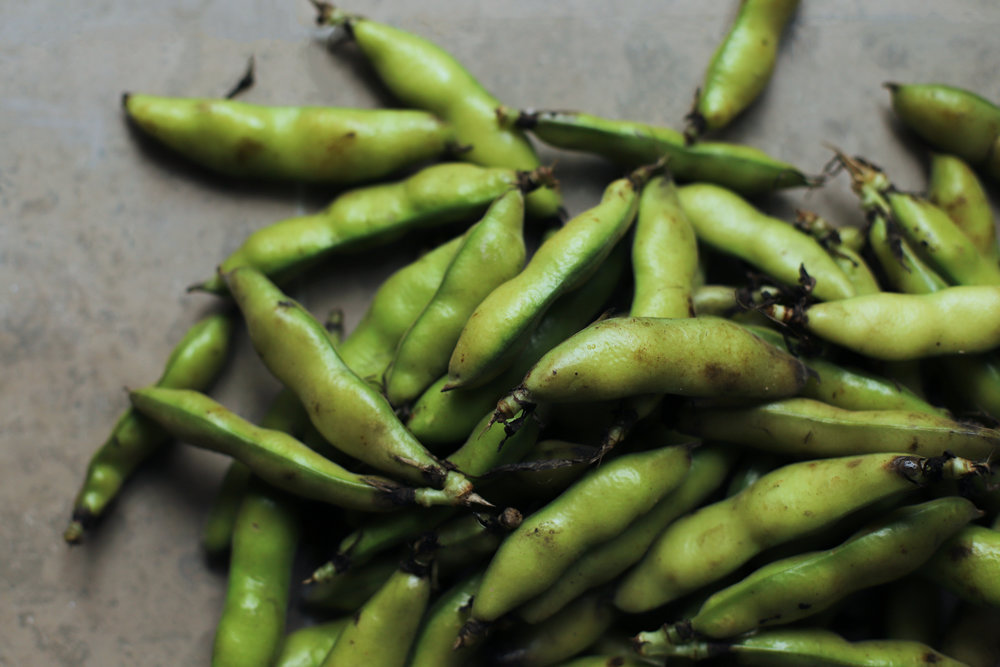
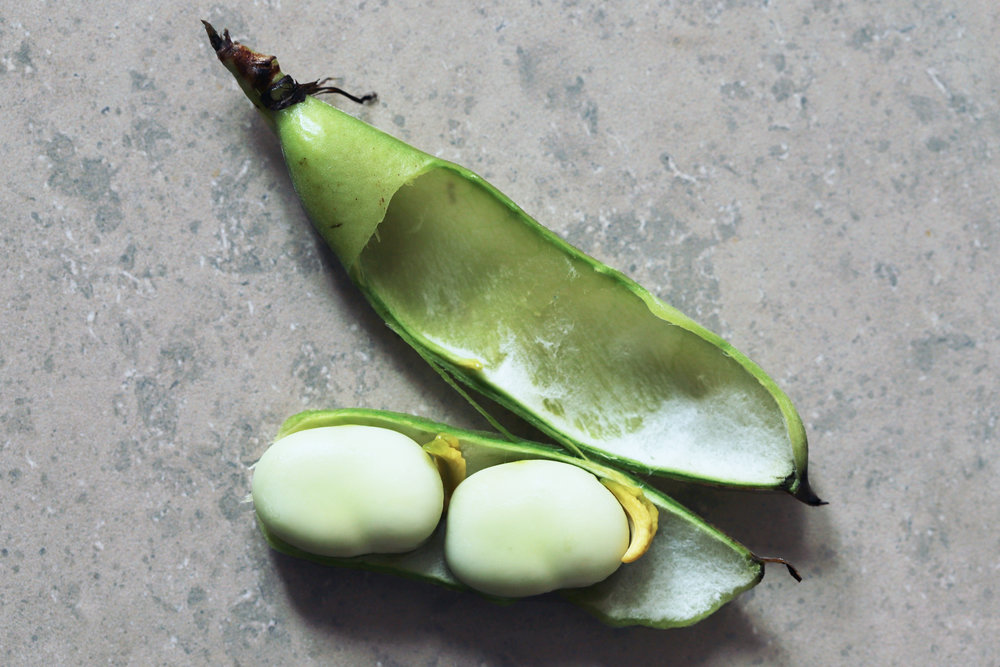
fava beans, in-shell

Fava beans are lower-maintenance than they seem

1) shelling fresh fava beans is easy (if you use my method)

After a week of fava bean experiments, I’ve landed on a shelling method that is way faster than the popular “string-removal” technique.

You know the method everyone says you should try: break off the top bit, pull the string down one side, then the other, and—supposedly 🙄—the pod splits open like magic. Except… it doesn’t! For me, the strings never slice deeply enough, so I’m left clawing at the stubborn shells like it’s 1998 and I’m trying to peel that sticker off the top of a CD case.

✨ There is a better way!

The outer shell

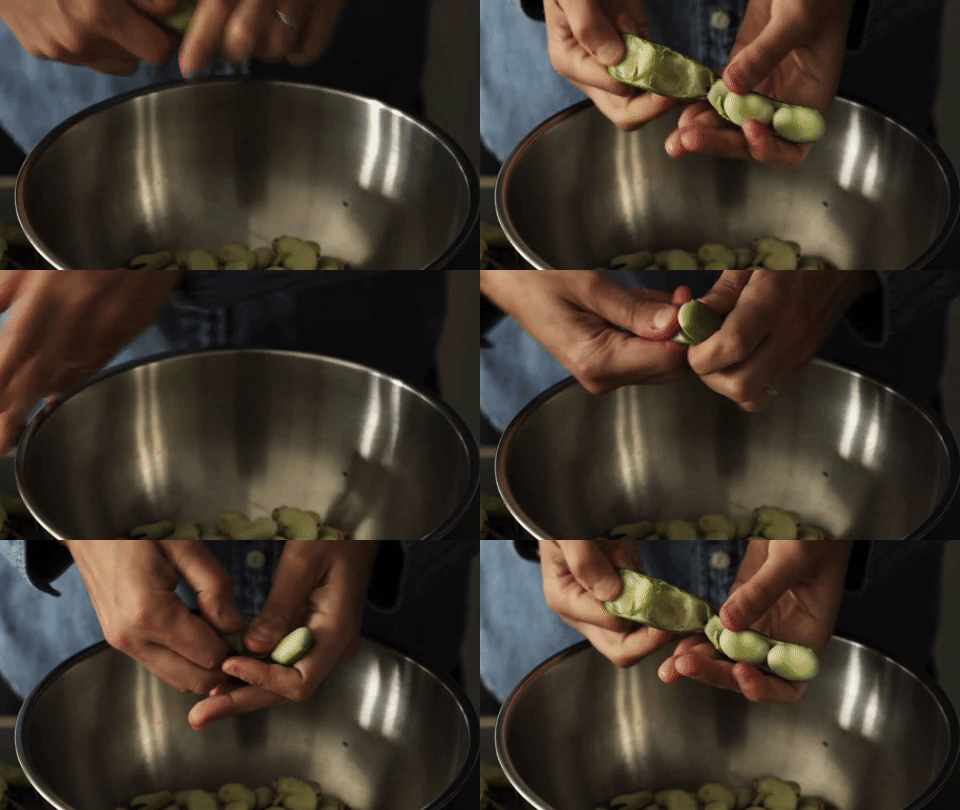
Here is the gist (see photos and GIF below): Hold the tippy-top of the stem flat between your thumb and the side of your index finger, then snap it backwards in one smooth motion. Use the flap you just created like it’s a pull tab. Then (and this is the key!) pull one entire side of the shell off in one clean motion.

It’s quick, easy, and honestly kind of fun. Once you get a rhythm going, you’ll be breezing through in seconds.

The inner skins

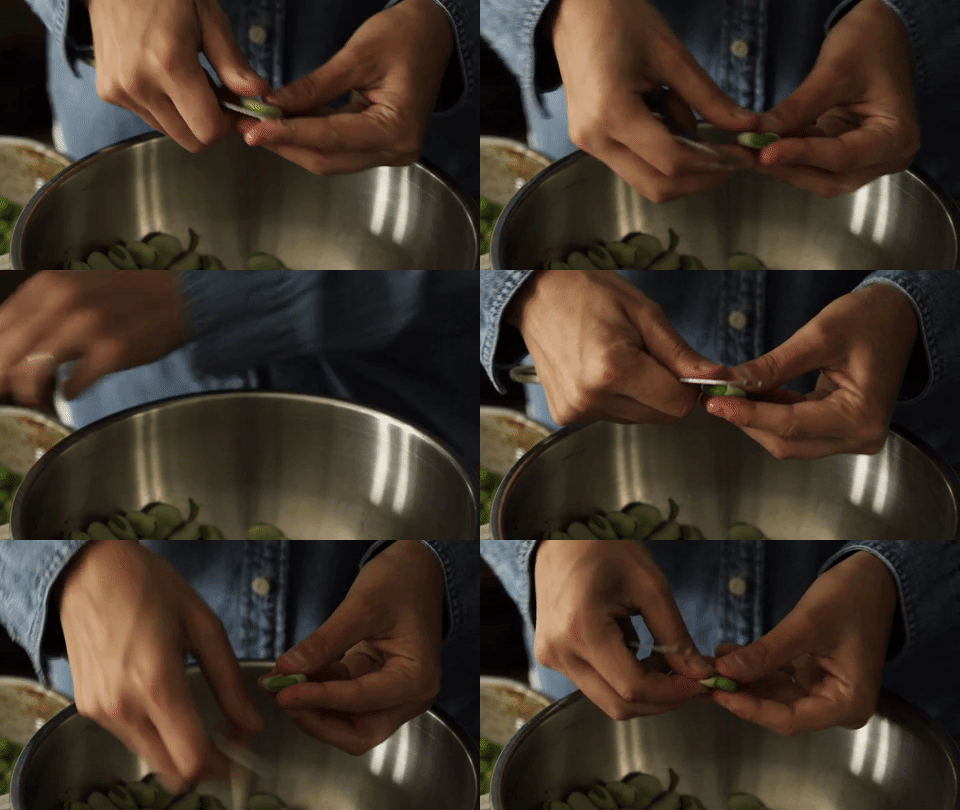
Peeling the inner skin from the pod is simple as well. After shelling, you’ll blanch the beans and then peel off the pale, inner skins. Just use the flat side of a paring knife and the side of your thumb to pinch the edge of the membrane, and pull. Then just pop the bean out of the slit you’ve made.

See the GIFs below, and you’ll see just what I mean.
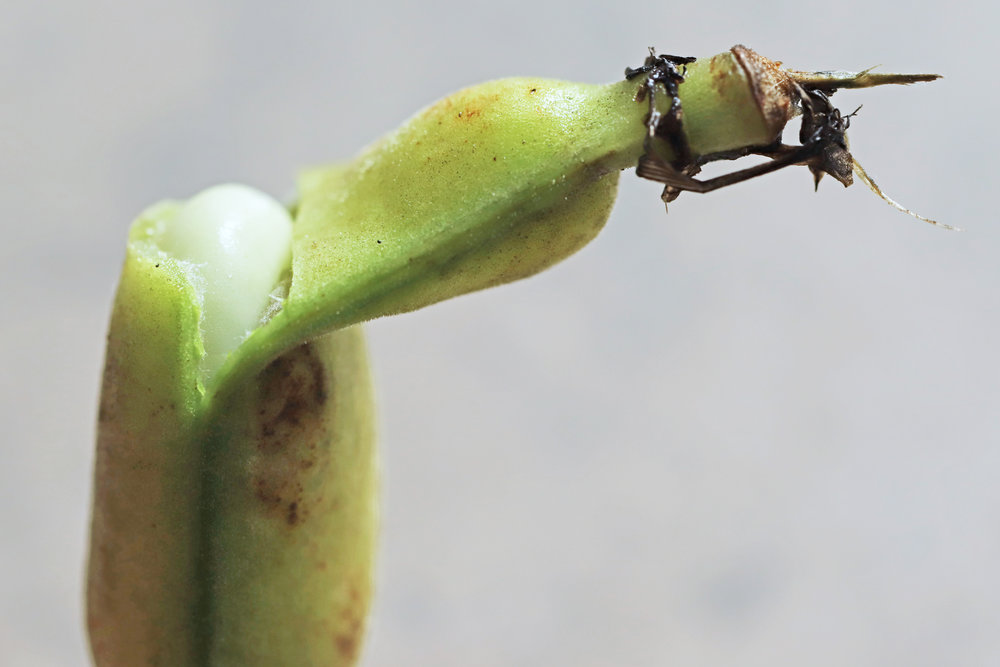
fava beans, shelling
fava bean, shelling
shelling fava beans
shelling the fava bean pods (shown here once at normal speed, then once slowed down)
shelling fava beans
peeling the membranes from the beans (also shown at both speeds)

2) they don’t have to be pretty on the outside

My friend Abeer and I were recently having a conversation about how much pressure there is these days for produce to look picture-perfect. But often, a few blemishes are no big deal—like the spots on ripe persimmons or the chalky “bloom” on old chocolate, which melts away with heat.

Fava beans fit right into this category. Their pods tend to look a little rough—scuffed, bruised, like they’ve seen some things. But the shells don’t matter much, since you’re tossing them anyway. The beans inside are what count, and they’re usually in great shape. If you’re unsure, you can ask the produce seller whether you can pop one open to see for yourself.
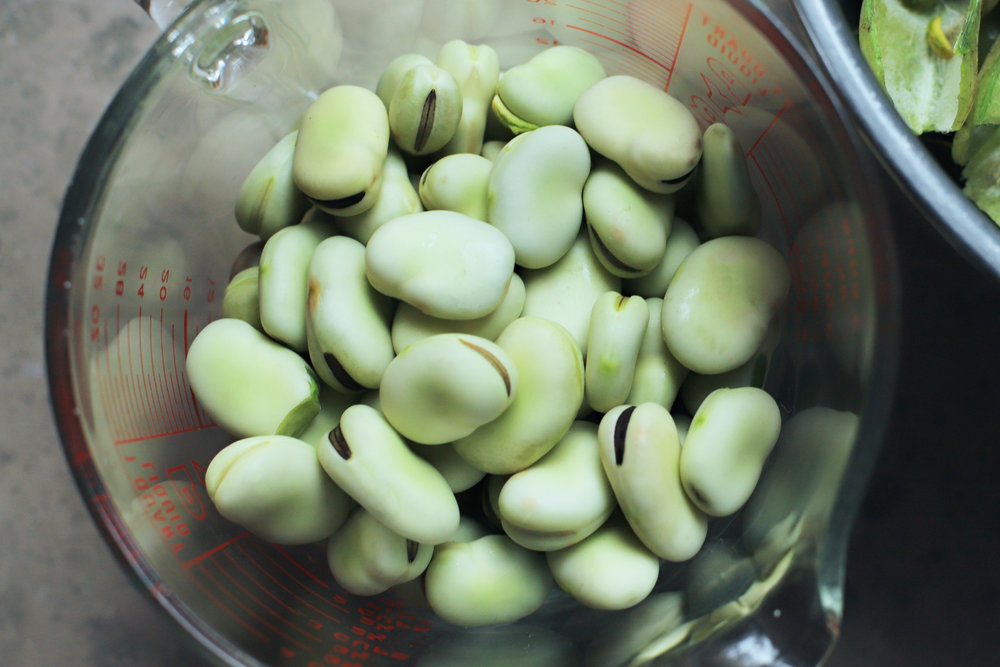
shelled fava beans

3) fava beans are best kept simple

Yes fava beans take a little extra prep. But the good news is that they don’t need much else. While some purists might claim that they’re at their best right out of the blanching pot, I think they need like 2 additional minutes to impart some fat and flavor. This lets their flavors really sing.

In the recipe below, you’ll sauté the peeled beans in a generous amount of butter, then finish with a touch of garlic, sesame (optional), and lemon juice. That’s it. It’s barely more effort than eating them plan, but the result is rich, bright, and totally worth the shelling time.
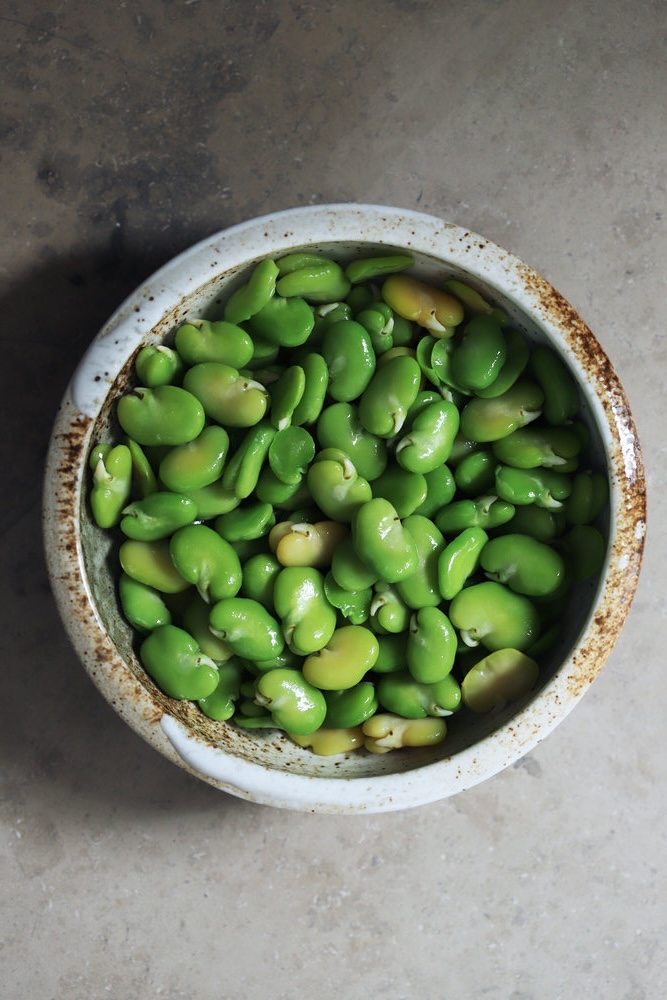
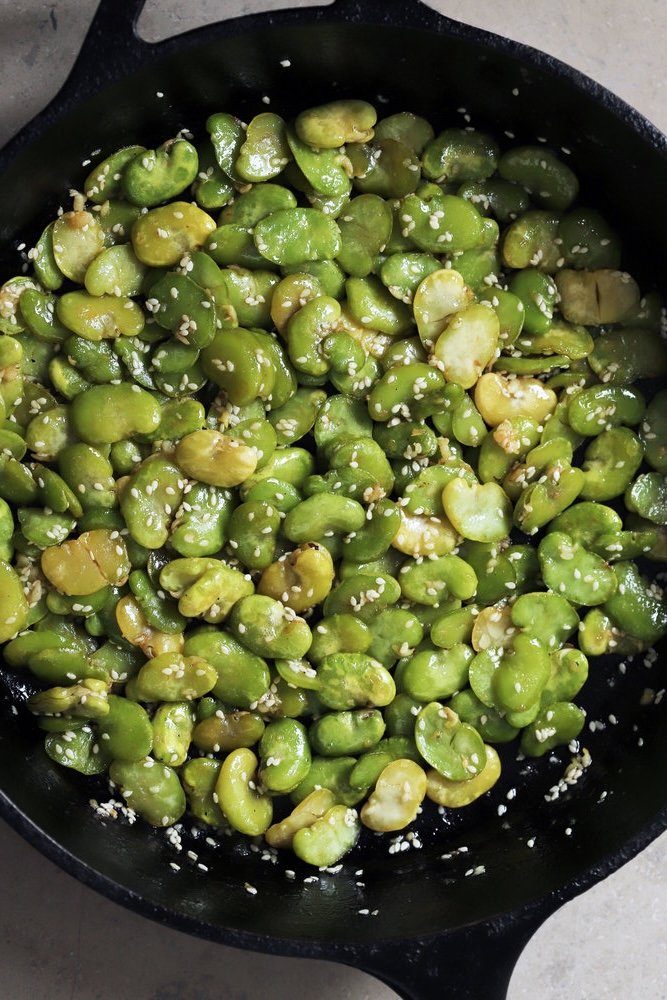
fava beans
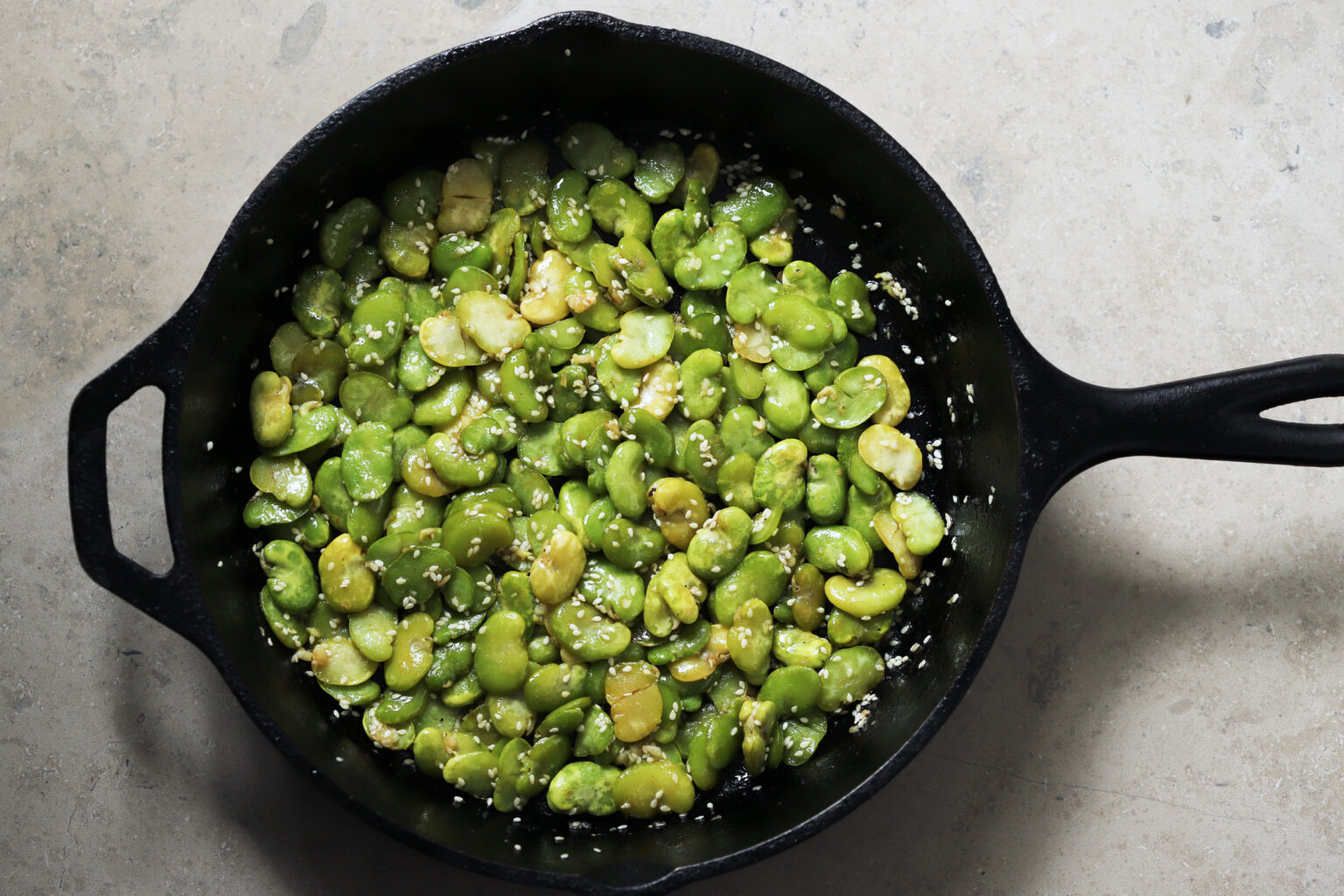
fava beans, sautéed with butter and sesame

Allergy warning: Some people have a genetic enzyme deficiency, which can make it dangerous to eat favas. Read a little about favism to make an informed decision about whether to try them, and be sure to inform your guests too. If you’re looking for a good substitute for this recipe, try cooking about 2 cups of shelled, fresh soy beans this way.

Print

fresh fava beans with butter and garlic
fresh fava beans sautéed with butter and sesame seeds
Print Recipe

5 Stars 4 Stars 3 Stars 2 Stars 1 Star

5 from 1 review

  • Prep Time: 20 minutes
  • Total Time: 30 minutes
  • Yield: 4 servings

Ingredients

  • 1 3/4 to 2 pounds fresh fava beans (in their shells)
  • 4 tablespoons butter (see note below)
  • 1/4 teaspoon salt (or more to taste)
  • 1 to 2 cloves garlic, crushed with a garlic press
  • 2 teaspoons to 1 tablespoon lemon juice (to taste)
  • 1 tablespoon sesame seeds (optional)

Instructions

  1. Bring a large stockpot of water to a boil over high heat.
  2. While you wait on the water, peel the outer shells from the fava beans. Here’s the easiest way to do this: using your thumb and the side of your index finger, pinch one end flat and feel for the hollow part right above one of the beans, then snap it back so half of the tip is severed, and then roll half of the bean back over your index finger, while peeling the other half away with your other hand (see the above GIF and photo). Pop out the pods and discard the shell.
  3. Once the water is boiling, add the shelled fava beans and boil for 45 seconds. While they’re boiling, fill a bowl with ice water.
  4. Strain the fava beans in the sink, and then immediately shock them in the ice water for about 3 minutes. To finish prepping the beans, peel the membranes. The easiest way is to carefully use a paring knife and your thumb to peel away a patch of film, and then pop the bean out (see the above GIF). Some of them might come out split in half, which is totally fine. this takes about 5 seconds/bean–a little longer than the shells, but also not too bad. Make sure they’re nice and dry before proceeding.
  5. Melt the butter over medium-high heat. Let it bubble for about a minute after it melts (careful not to let it brown or smoke), and then add the prepped favas and salt. Cook stirring every 30 seconds for about 5 to 6 minutes, until the beans are a little creamy on the inside, and no longer mealy. Lower the heat if the butter begins to brown. In the last minute of cooking, add the garlic. *
  6. Add the sesame seeds and lemon juice, toss together, and serve.

Notes

* If you don’t want all that butter to end up in the final dish: after letting the garlic sizzle for a few minutes, you can carefully pour off the remaining butter, or use a paper towel to sop some of it up. You must do this while the beans are still sizzling in the butter, and before you add the sesame seeds and lemon juice. Doing it this way, you can get rid of 1 to 2 tablespoons of butter. (If you’re wondering, I like to leave all 4 tablespoons.)
find us on instagram and let us know what you made!

Filed Under: dinner, every recipe, gluten free, meze, side dishes, vegetarian Tagged With: beans, fava beans, garlic, sesame

recording your family recipes

March 31, 2018 by Kathryn Pauline 12 Comments

I recently posted on instagram asking if folks might be interested in a how-to post about recording family recipes, and I was totally stunned by the overwhelmingly positive response, so I’ve put together this list of strategies and tips I’ve learned while working with my grandmother, mom, aunties, and cousins.

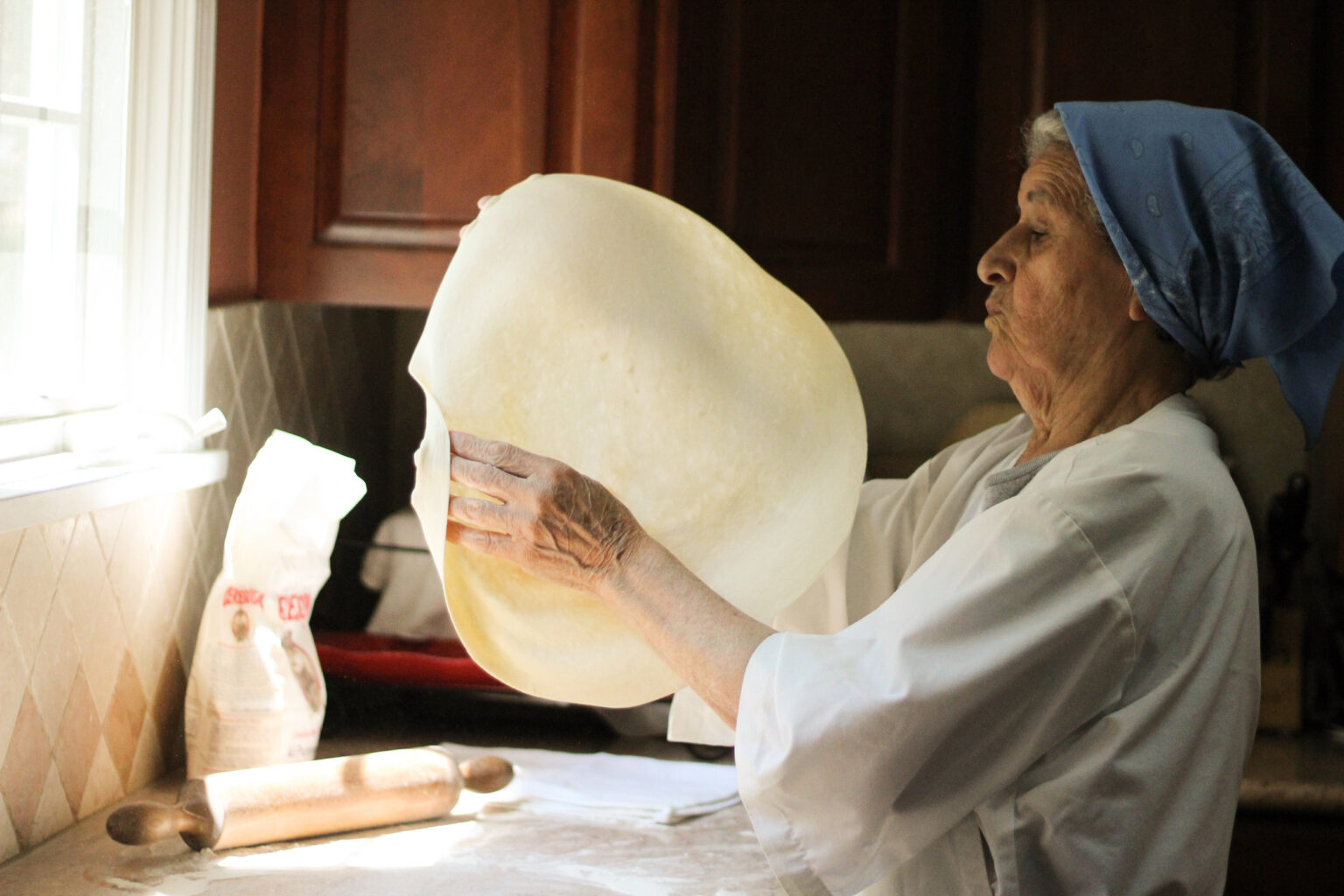
  • My grandmother stuffing eggplant for sheikh mahshi
  • My aunt Masy teaching my cousin, Olivia, how to make kbeibat
  • My auntie Geeto making ma’amoul
  • My mom making vegan stuffed grape leaves

If you’ve ever tried to teach someone how to cook something by writing up instructions, you know that recipe developing is a totally separate skill from cooking great food, and the process of translating actions into words can be a little tricky. Taking someone else’s cooking, and trying to translate it into a recipe is even more complex. But that’s ok, because there are just a few things you’ve got to keep in mind to make everything run smoothly.

I should say, before I get to my list of tips, that this is just my way of recording someone else’s recipe. My method is a little on the sciencey side, but there are of course lots of other ways that work better for others. Sometimes just getting your hands dirty and pitching in works better than carefully recording every single detail, especially if you’re just trying to learn how to make something yourself, rather than writing down a recipe for friends, family, and posterity. So take my advice with a grain of salt, adopt whatever suggestions you find useful, and figure out what works best for you and your family. And if this all seems really overwhelming, feel free to skip directly to numbers 10 and 11.

My grandmother making kift’it tkhuma

1) Have a conversation before setting foot in the kitchen. Ask specific, non-leading questions to get an idea of how the dish is made, but don’t worry so much about measurements and times quite yet.

First, ask them to explain how to make the dish and take notes, but stay flexible later on when you actually observe them cooking. Don’t get too hung up on figuring out temperatures, amounts, and times during this part—you’ll record all of that when you actually start cooking. Instead, ask lots of questions about the cooking process and steps. Try to make your questions specific, but not leading. Specific questions are focused on one particular idea, and non-leading questions don’t stab randomly at possible answers.

For instance, if you’re told that you’re supposed to soak the bulgur in cold water, it’s better to ask “what kind of bulgur should I use?” instead of asking “will just about any grade of bulgur work for this?” If I were to ask my grandmother the second question, she would say “Sure, you can use whatever you have on hand,” because she would feel bad for me and wouldn’t want me to have to go to the grocery store to get a particular ingredient, even though it’s absolutely imperative to use extra-fine bulgur in certain dishes. The first question is specific and open-ended. The second question, while also specific, is leading.

“Why” questions are sometimes useful at this stage; for instance, “why can’t you use coarser bulgur for this? Why do you soak the bulgur in cold water instead of hot water?” and so on. This will give you a richer understanding of the dish before heading into the kitchen. Channel your inner three-year-old and ask “why yada yada yada?” when something interests you or doesn’t make sense.

2) Let your family member know how you plan to record their recipe, and ask them to make sure they’re okay with your plan.

Second, tell them a little bit about how you’re going to record their recipe. Explain the importance of measuring everything exactly (amounts, times, temperatures, etc.), and really emphasize this point. While they can probably cook the dish blindfolded, with one hand tied behind their back, it’s important to record everything carefully so that you can learn how to make it and teach others. Ask them to give you a warning before they add an ingredient, so you can reset the scale and record it. Also let them know what the recipe is going to be for (e.g., you’re making a family cookbook to send to all the cousins, or you’re just going to use the recipe yourself, etc.), and make sure they’re happy to share before you send it to everyone you know.

3) Don’t ask “how many cups do you add?” if your family member doesn’t normally use measuring cups.

Like many experienced home cooks, my grandmother and great aunt don’t normally cook with measuring tools. When I first started recording their recipes, I used to ask them to use measuring cups and spoons while we cooked together, so that I could record the amounts they use. But I soon found that this actually had a tendency to change the way they cooked; in other words, when they used measuring cups and spoons, the food wouldn’t turn out exactly the same as it does when I wasn’t observing them cook, because the act of measuring with an unfamiliar tool changes a cook’s intuition about how much of something to add. Which brings me to number 4…

4) Instead, use a digital scale.

Instead of measuring cups, I like to use a means of measurement that doesn’t actually interfere with their usual work flow: the digital scale. If you want to carefully record family recipes, it’s a good idea to invest $20 in a digital scale with a tare feature (i.e., a feature that lets you zero out the weight after adding an ingredient). Simply ask your family member to alert you every time they’re about to add an ingredient, and ask them to give you a second to hit the tare button and record the amount (and be sure to thank them for their patience!). Measuring in grams is a good idea, because it gives you a more exact measurement than ounces (you can always convert to ounces later).

If you want your final recipe to be in volumetric measurements (e.g., cups, tablespoons, etc.), you can easily go back later and figure out how much each weight is volumetrically. For instance, if your grandmother uses 70 grams of sugar, you would later weigh that amount and measure how many cups it comes out to (I normally do this when I later test the recipe).

5) Don’t forget to pay attention to qualitative things, like technique and assessing doneness.

Cooking is about much more than quantities of ingredients. Note the techniques your family member uses. Ask them questions about their method, and (most importantly) participate in the cooking process and ask for feedback. Ask them “How should I have done this differently? What’s the most important thing to make sure I do this step correctly? What are some potential things that could go wrong in this step? Why did you do it this way and not that way?” Record what you’ve learned.

Likewise, it’s important to ask about how to assess doneness at different stages in the cooking process. Ask specific, non-leading questions like “How do you know when to remove from heat? Do you notice a certain smell? Does the food look a certain way? Does the simmering change the way it sounds? Does the food reach a certain temperature? Does a certain amount of time pass?” On the other hand, if you vaguely ask “how do you know when it’s done?”, you might be met with an equally vague answer like “you just know.” And if you ask a question that’s too leading like, “is it done when it reaches 165° F?”, you might be met with agreement even though your guess was totally off (because it’s kind of exhausting to have to correct someone over and over again who keeps guessing the wrong thing). Again, the earlier list of questions are specific, but non-leading, which will result in more helpful answers.

6) Buy an egg timer that counts both down and up.

If your family member doesn’t normally time how long something takes to cook, they might over or underestimate the amount of time if you ask them beforehand. But that same family member probably cooks flawless food every single time, without once looking at a clock. Again, the act of observation can sometimes change the way someone cooks; so to minimize this effect, I usually set my timer to count up instead of down, like a stopwatch. I set the stopwatch once it comes to a simmer, and then when the alarm goes off in my grandmother’s mind, she turns off the heat, and I record how long it took. This works much better than asking “how long is it supposed to take?” and then setting a timer for that amount of time.

You could of course just use your phone for this, but I hate using my phone as a timer (I like being able to hit the start/stop button with my elbow when my hands are dirty, I like not having to unlock a screen, and I like that it’s hard to forget that the timer is running, since it’s not just one of a million screens open on my phone). Look for one that counts both ways and has an easy-to-press button on the top.

7) Use a thermometer when necessary.

The same above principle goes for temperature. My grandmother and great aunt take the temperature of milk, bread dough, etc. just by feeling it. Instead of asking “what temperature should this be?” I ask them to bring it to the temperature it should be at, and then I use a digital thermometer to record the degree. My aunt Masy in particular is, like, shockingly consistent with temperatures (to the exact degree, every single time), even though she never actually uses a thermometer. But that doesn’t mean that the temperature can’t be recorded with a tool, so that a mere mortal like me can bake as consistently as her.

8) Take notes during cooking.

The pre-cooking interview is helpful, partly because then you won’t have as much to write down while you cook, but there will still be lots of things to record while you cook together. Don’t forget to record times, the oven temperature, the stove heat (e.g., medium, low, or high heat), and other crucial details. It can be tricky to multitask like this, so you might want to ask another family member to help out as a scribe.

9) If you can, and especially if you’re going to share the recipe with others, test it again on your own.

This step is an important part of making sure you didn’t leave out any crucial steps or ingredients. If you’re just writing this for yourself, you can use your own discretion about whether to test it, but if you’re going to give this recipe to anyone else (i.e., emailing it around or posting it on a blog), definitely make sure you cook it at least once more on your own, as written. If something seems off, call your family member and troubleshoot, tweak the recipe, and try again.

10) Ask for help and give everyone a particular purpose.

I do all the photography, recipe developing, and everything when I record family recipes, but it’s definitely a lot for one person to take on, especially if it’s not your full time job. If this all sounds a little overwhelming, ask for help, and assign people jobs based on their abilities and interests. Maybe your sister wants to take photos, and your mom wants to take notes for you while you’re cooking. There’s no such thing as too many cooks when everyone has an assigned role.

11) Don’t get overwhelmed! There are so many ways to record your family’s recipes.

Ok, so this is kind of an intense list of things. But don’t let this post intimidate you out of recording your family recipes. Everything doesn’t have to be a precisely recorded chronicle, and there are plenty of ways to preserve family recipes. Just simply cooking together and learning from demonstration and practice is a great way to figure out how to make something.

Even if you aren’t able to be with your family in person, there’s always a way. If you don’t live in the same place as your family, asking your grandmother on the phone how she makes something can work great (and you can use some of the above questions to get the conversation going). Even if you feel like you missed your chance, it can be so rewarding to backwards-engineer a beloved lost recipe from a late relative, based on the fond memories you have of enjoying the dish together. Or maybe you’ve been given the gift of your late grandmother’s carefully recorded recipes. There are so many ways to connect with your family’s food traditions; the important thing is just that—to connect!

Filed Under: cooking guides, family recipes, recipe writing

  • « Go to Previous Page
  • Page 1
  • Interim pages omitted …
  • Page 127
  • Page 128
  • Page 129
  • Page 130
  • Page 131
  • Interim pages omitted …
  • Page 183
  • Go to Next Page »

Primary Sidebar

Kathryn Pauline smiling

Welcome! I’m Kathryn Pauline, cookbook author, recipe developer, and photographer.

Footer

read our privacy policy

© 2017 - 2026 Kathryn Pauline