• Skip to primary navigation
  • Skip to main content
  • Skip to primary sidebar
  • Skip to footer
Cardamom and Tea
  • Blog
  • Recipes
  • About
  • Cookbooks
    • Piecemeal
    • A Dish for All Seasons (my first cookbook)

samoon

April 12, 2017 by Kathryn Pauline 2 Comments

In the United States, Middle Eastern bread is almost always very flat. Pita and lawash have become so ubiquitous, you can always find one or the other in any major American supermarket. And I would never complain about this flatbread craze, since these breads are undeniably delicious. But all this is enough to make a person think that pita and lawash are the only two kinds of Middle Eastern bread, which is of course not the case. My family eats, bakes, and buys a variety of different Middle Eastern breads. But when one of us requests some “bread” without specifying which type, you can assume they mean samoon.
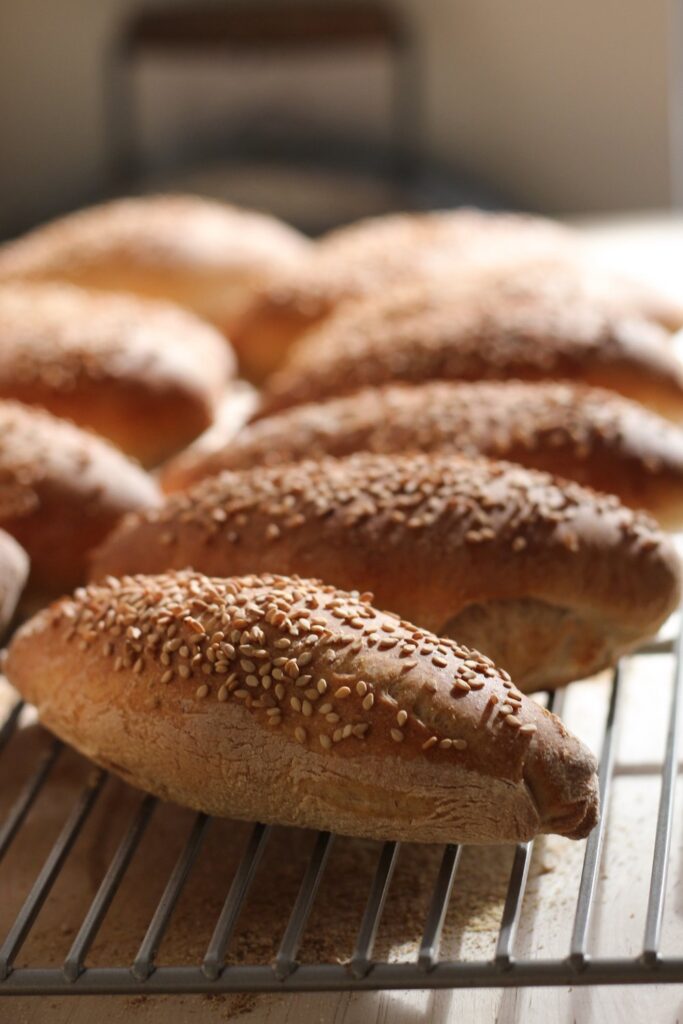
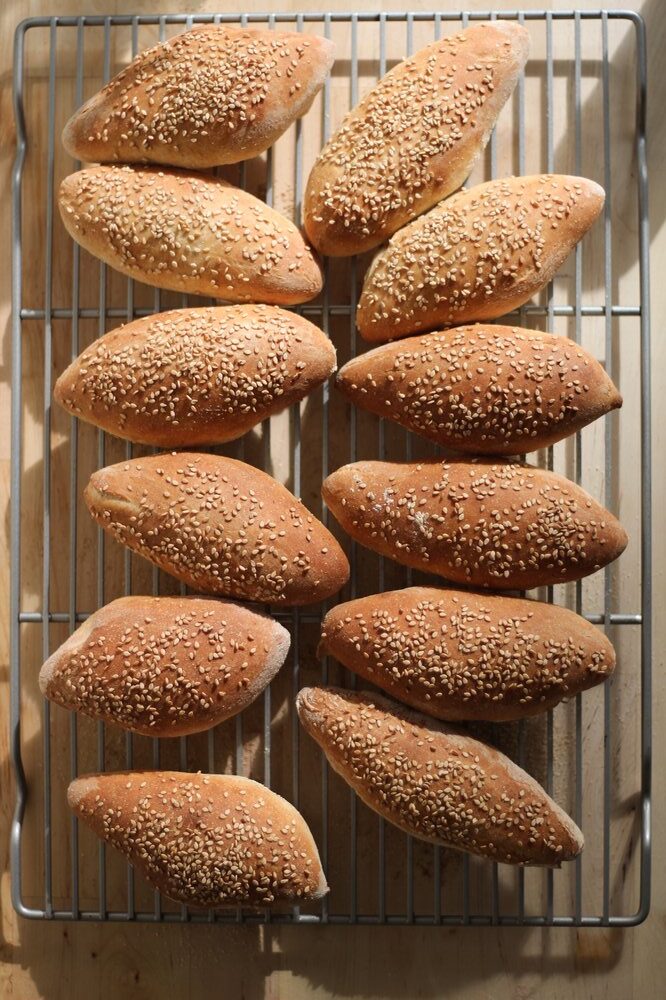
While samoon is primarily known as an Iraqi bread, it’s eaten in many different parts of the Middle East and Mediterranean. And with such a broad reach, samoon varies from place to place and doesn’t always look and taste exactly the same.

The market my family shops at in Chicago carries a version that’s very much like this recipe. But you’ll also find places with bigger seedless loaves that are cooked at a higher temperature and become slightly charred instead of golden.

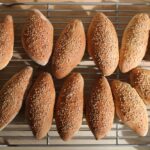
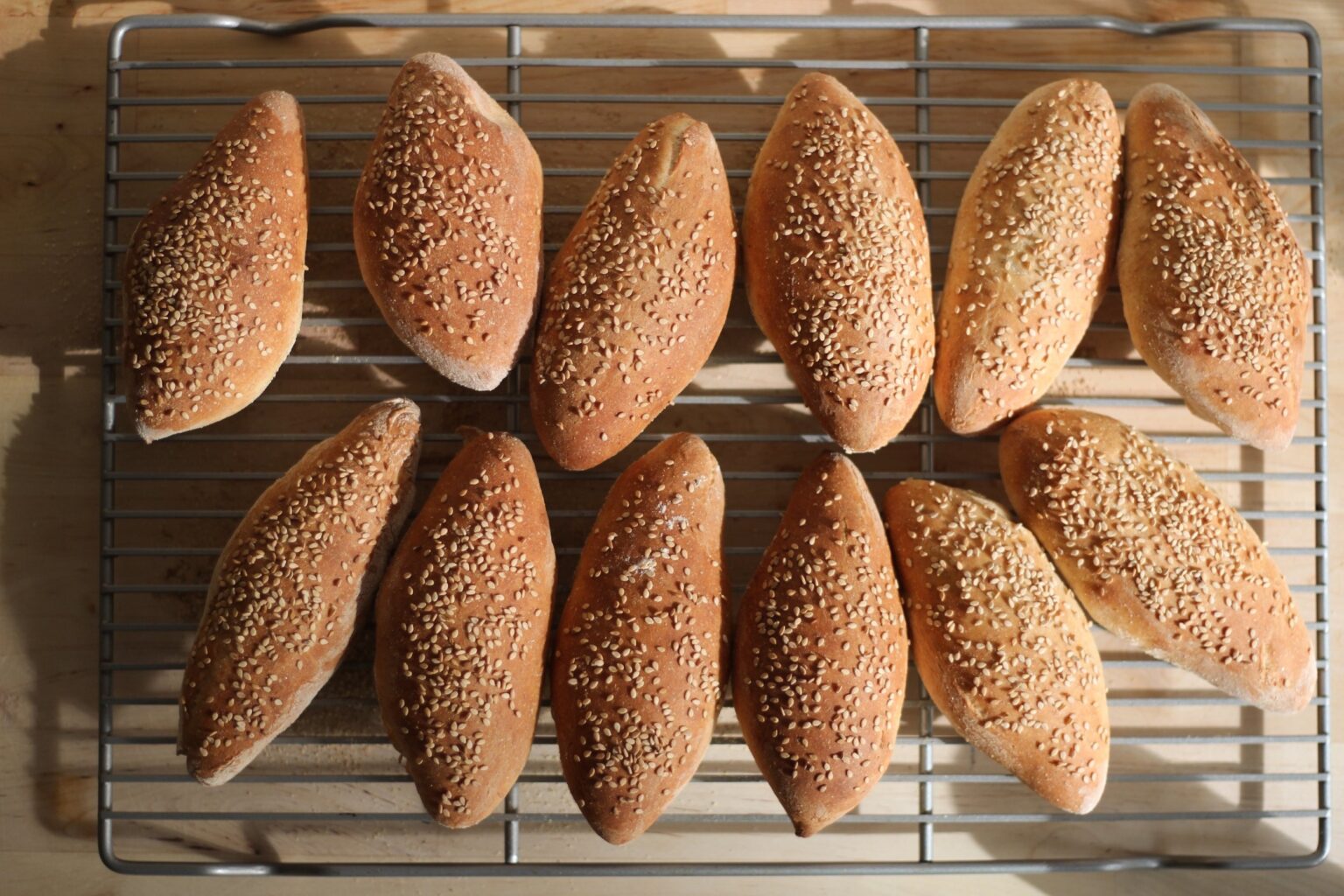
Some versions of samoon even look almost like flatbread. Each variety is unique and absolutely delicious, but the thing that unites them all is their pointed oval shape. If you’re not one of the lucky ones who lives near a samoon bakery, you can use this recipe to make your own. But even if you have a samoon shop near you, nothing beats homemade bread.
Print

samoon

Print Recipe

5 Stars 4 Stars 3 Stars 2 Stars 1 Star

No reviews

  • Yield: 12 rolls

Ingredients

  • 1 1/2 teaspoons dry active yeast
  • 1 teaspoon sugar
  • 1 1/3 cups + 3 tablespoons tepid water, measured separately
  • 5 ounces wheat flour (about 1 cup)
  • 14 ounces white flour (about 3 cups)
  • 1 tablespoon yogurt or buttermilk
  • 2 tablespoons butter, melted
  • 1 1/2 teaspoon fine salt
  • 1/4 c corn meal or semolina flour
  • Additional water for brushing
  • 2 tablespoons sesame seeds, for sprinkling

Instructions

  1. Proof the active dry yeast with the sugar and 1 1/3 cups of the water until the water looks a little foamy on top (about 5-10 minutes).
  2. Add the wheat flour, white flour, yogurt, melted butter, and salt to a bowl (the bowl of a stand mixer, if you plan to knead by machine).
  3. Add the water/yeast/sugar mixture and stir until the dough starts to come together. If there is still a lot of flour or if the dough looks dry, gradually add 1 tablespoon of water at a time. The dough should be on the wet side; the dough ball should be a bit sticky, but it should hold together in a ball.
  4. Knead until the dough ball passes the window pane test. It should come together into a somewhat sticky elastic ball that has a smooth surface. Kneading should take about 5-15 minutes by machine with a dough hook, or 10-20 minutes by hand. Pay more attention to the dough’s consistency than the time you’ve spent kneading.
  5. Place the dough in a bowl, cover it, and let it rise at room temperature for about 1 hour and 30 minutes. It will rise noticeably. If it’s a little chilly in your kitchen (e.g., below 67° F), you might need to let it rise for about 15-30 minutes longer.
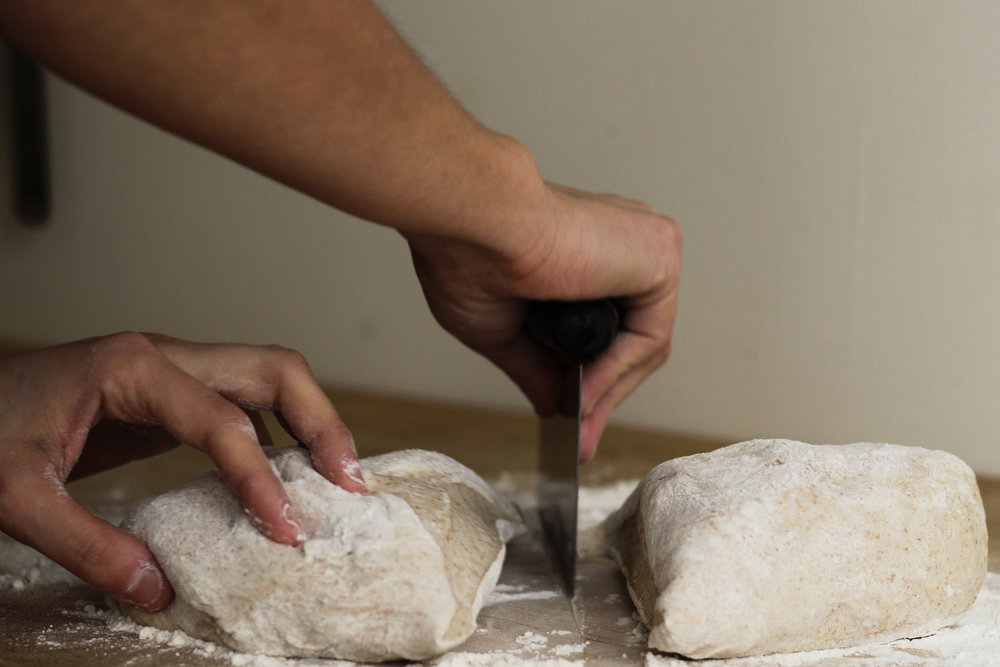
  6. Lightly flour a clean, food-safe work surface, divide the dough into 12 equal pieces, and shape each chunk into a round ball.
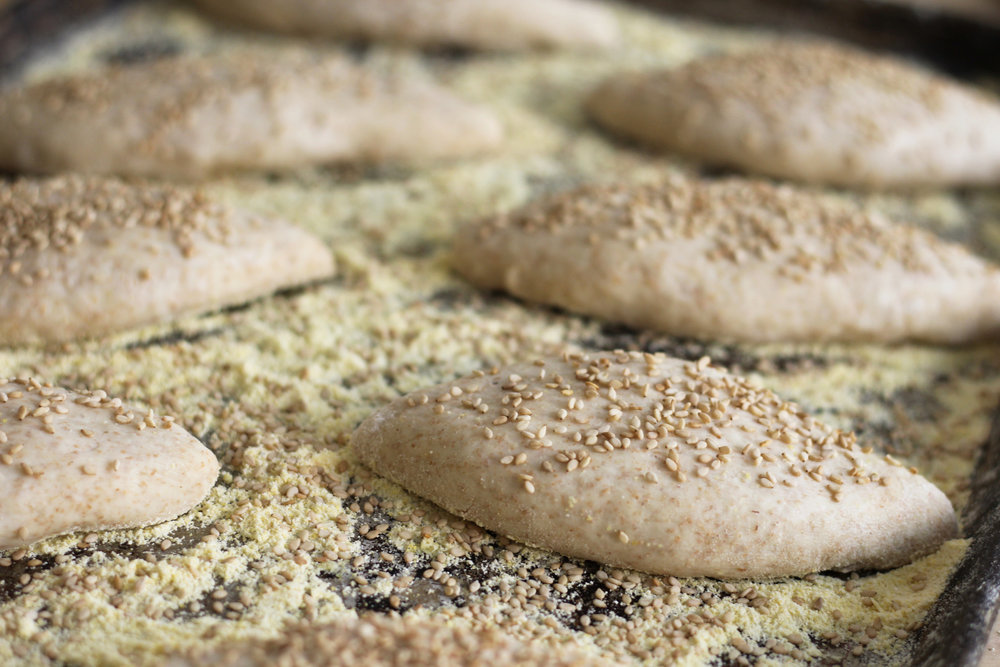
  7. Roll each ball into an elongated shape, sort of like a long football (see photo above). The ends should be a bit pointy. After you roll it into this shape, slightly flatten the football shaped piece with the heel of your hand. Pinch the ends of the football into points if they’ve become rounded.
  8. Sprinkle 1 or 2 sheet pans with corn meal or semolina and place the shaped loaves on the sheet pans, leaving a couple inches between each one.
  9. Brush each loaf with water and sprinkle with sesame seeds.
  10. Cover the loaves with plastic wrap and preheat the oven to 475° F.
  11. Once the oven has preheated and the loaves have risen for 30 minutes, bake them for 12-18 minutes, until they’re cooked all the way through and golden-brown on the outside.
  12. Cool on a wire rack.

find us on instagram and let us know what you made!

Filed Under: bread, every recipe, vegetarian Tagged With: middle eastern, sesame, yogurt

botanical baklawa (baklava)

April 9, 2017 by Kathryn Pauline 2 Comments

A few months ago, I was making quite a lot of buttery cardamom baklawa to make sure the recipe was absolutely perfect before posting it. Baklawa (also known as baklava) is the kind of thing where you make a huge batch and then share it with friends and family, so I was bummed that I couldn’t share any with my friend, Laura. She gave birth to a beautiful baby girl in October, and since she’s been breastfeeding, Laura has stopped eating dairy. So one day, when I was going on and on about baklawa (maybe it’s not surprising that this is something I tend to do), I asked Laura if she had any ideas for making it dairy-free, and she suggested replacing the butter with extra virgin olive oil. I was immediately intrigued because lemon olive oil cake is one of my favorite desserts—why not use the same flavors in baklawa?

So we got together to test out this theory, and as we suspected, olive oil works perfectly in baklawa. It somehow tastes even butterier than butter and makes all of the layers extra crispy, so they completely shatter with each bite. It might sound kind of strange if you’ve never tried using extra virgin olive oil in dessert, but trust me when I say that it absolutely does not make the baklawa taste like you drizzled it with a vinaigrette, or worse, kalamata olive brine. It just somehow works.

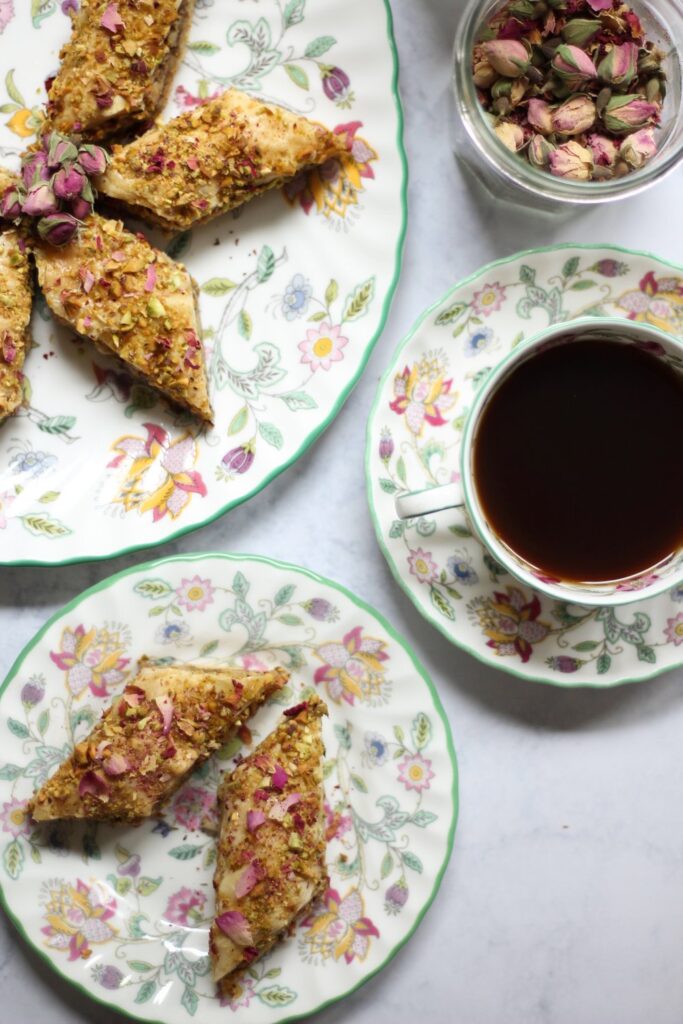
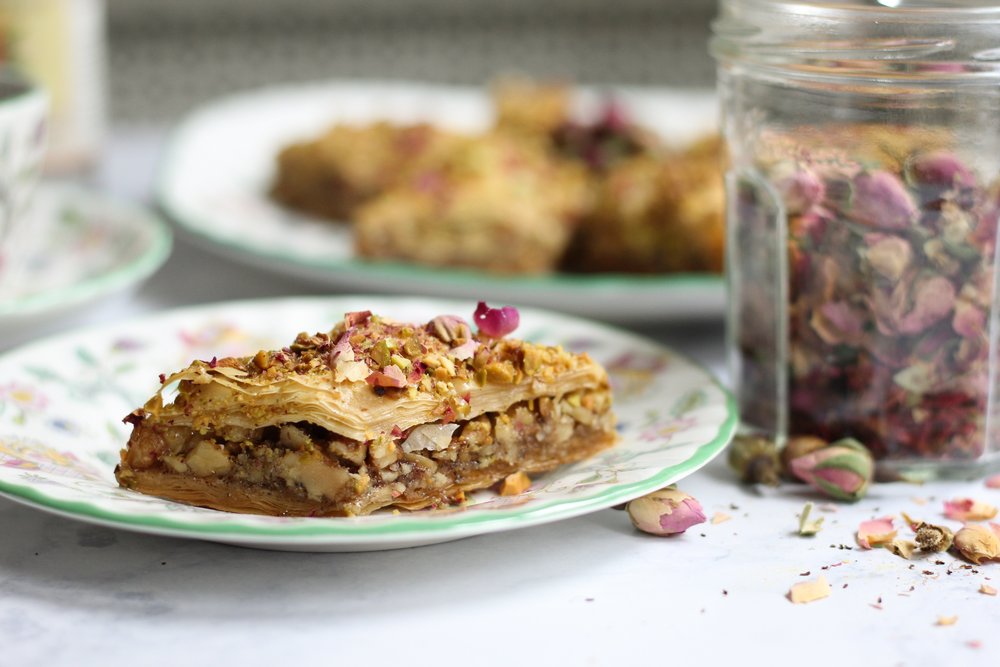
The olive oil adds another interesting nutty flavor to the walnuts and pistachios, especially when the pistachios are a little roasted. I decided to add rose, which is a very traditional baklawa flavoring, to contrast with these earthy flavors. Rose petals and rosewater add an intoxicating fragrance that brings out the botanical qualities of the olive oil, cardamom, cinnamon, and honey. When the fragrant honey and rosewater hits the earthy, crispy filo, walnuts, and pistachios, the whole thing smells like a rainy garden.

After our successful olive oil experiment, I called my grandmother, the woman who first taught me how to make baklawa, to tell her the exciting news about our innovation. She listened patiently to my story, and then casually broke the news to me, her millennial granddaughter, that this has certainly been done before. “We used to make baklawa with olive oil whenever the bishop or cardinal would come to our house. We would make everything with olive oil because they keep a vegan diet.” So there you have it: there is nothing new under the sun.

Print

botanical baklawa (baklava)

Print Recipe

5 Stars 4 Stars 3 Stars 2 Stars 1 Star

No reviews

  • Prep Time: 35 minutes
  • Total Time: 2 1/2 hours
  • Yield: approximately 3 to 6 dozen pieces (depending on how you slice them)

Ingredients

  • 1 cup extra virgin olive oil, plus an extra tablespoon for greasing
  • 16 ounces walnuts, about 4 cups medium-chopped
  • 5 ounces powdered sugar, about 1 cup
  • 1 tablespoon ground cardamom
  • 1 1/2 teaspoons ground cinnamon
  • 1/2 teaspoon kosher salt
  • 16-ounce container of filo dough sheets (do not open until the recipe tells you to)
  • 16 ounces honey
  • 1 to 3 teaspoons rosewater (to taste) *
  • 1/2 cup + 2 tablespoons finely chopped pistachios
  • 3 tablespoons crumbled edible dried rose petals (optional) **

Instructions

  1. Preheat the oven to 350° F.
  2. Use the extra tablespoon of olive oil to grease a rimmed sheet pan (at least 12″ x 16″).
  3. Combine chopped walnuts, powdered sugar, cardamom, and kosher salt, and set aside.
  4. Once everything is mixed together, open the filo dough container and place half of the filo dough on the sheet pan. Be careful to work somewhat quickly so that the filo dough does not dry out.
  5. Spread the chopped walnut mixture evenly over the filo dough.
  6. Place the rest of the filo dough on top of the walnut mixture.
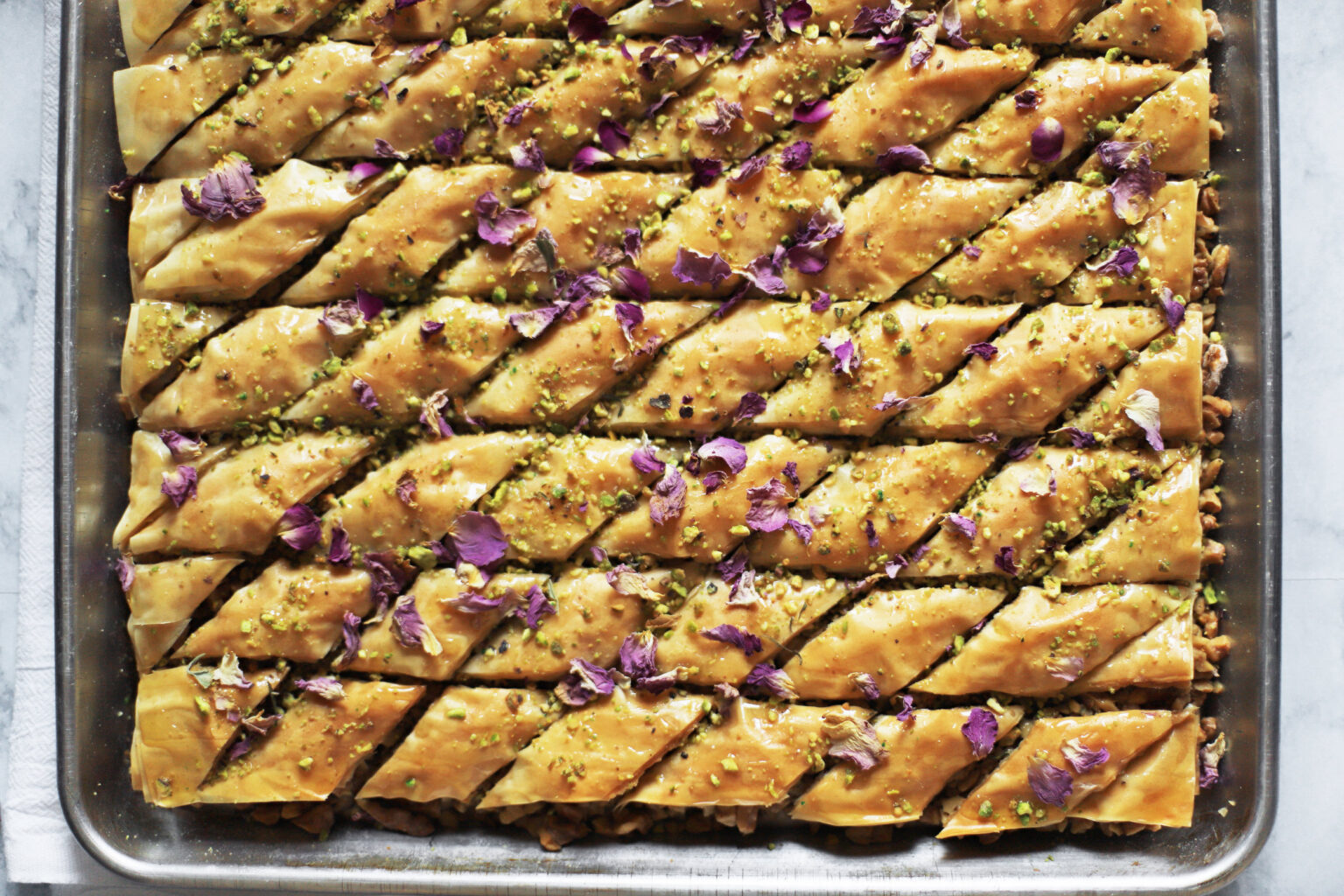
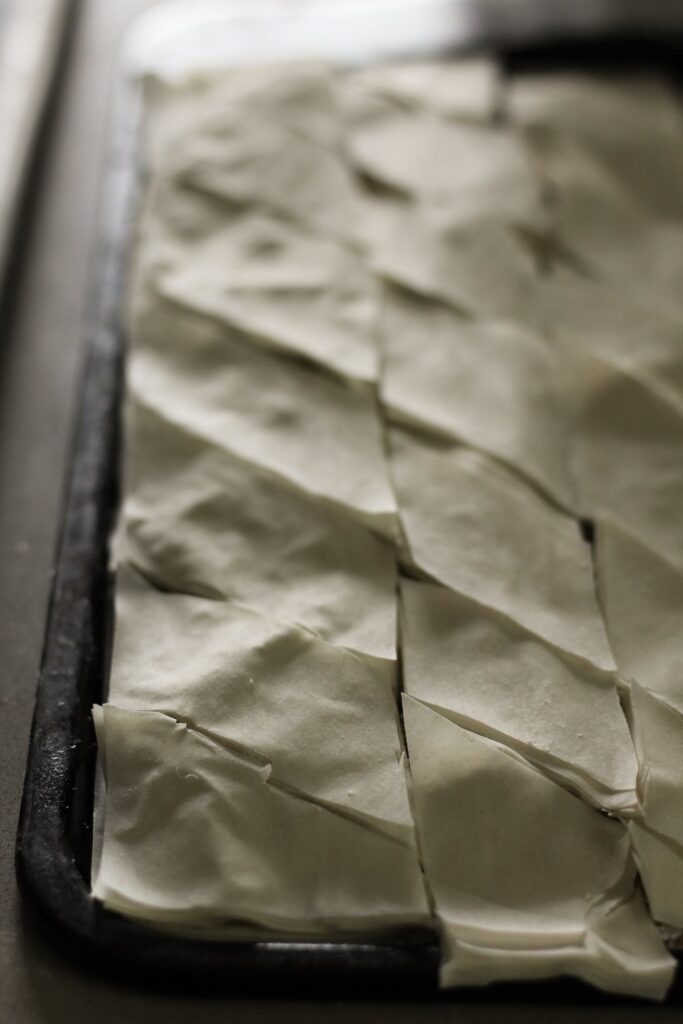
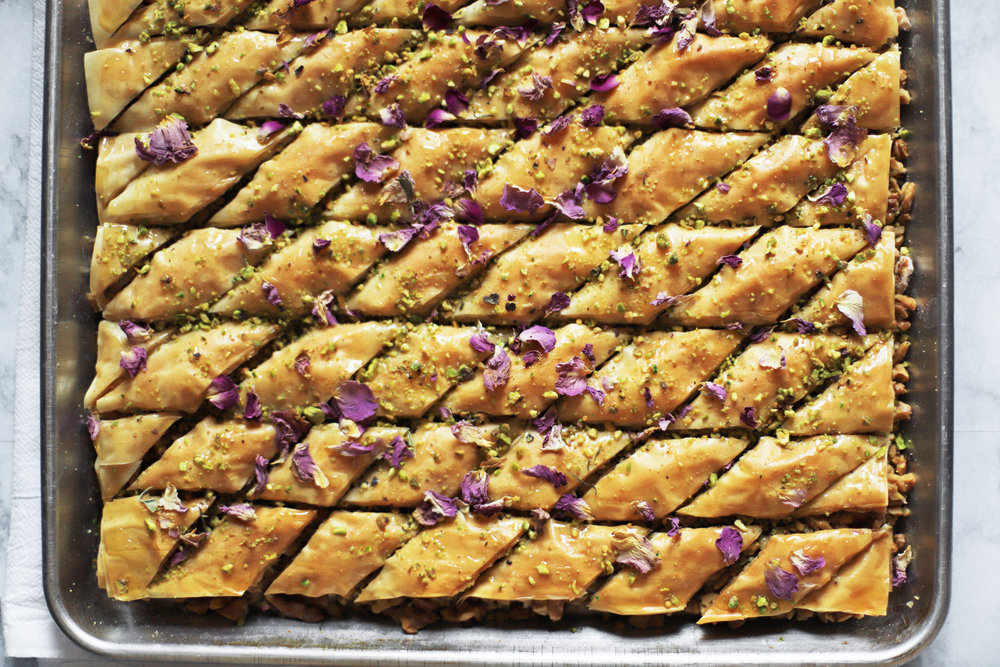
  7. Cut the baklawa into diamonds by slicing straight across in the short direction, then diagonally in the other direction (see more instructive photos here). It’s best to work with a very sharp or serrated knife so that you don’t tear, stretch, or dishevel the filo. It’s alright if a few of the pieces go a little awry, but you want everything to stay pretty lined up.
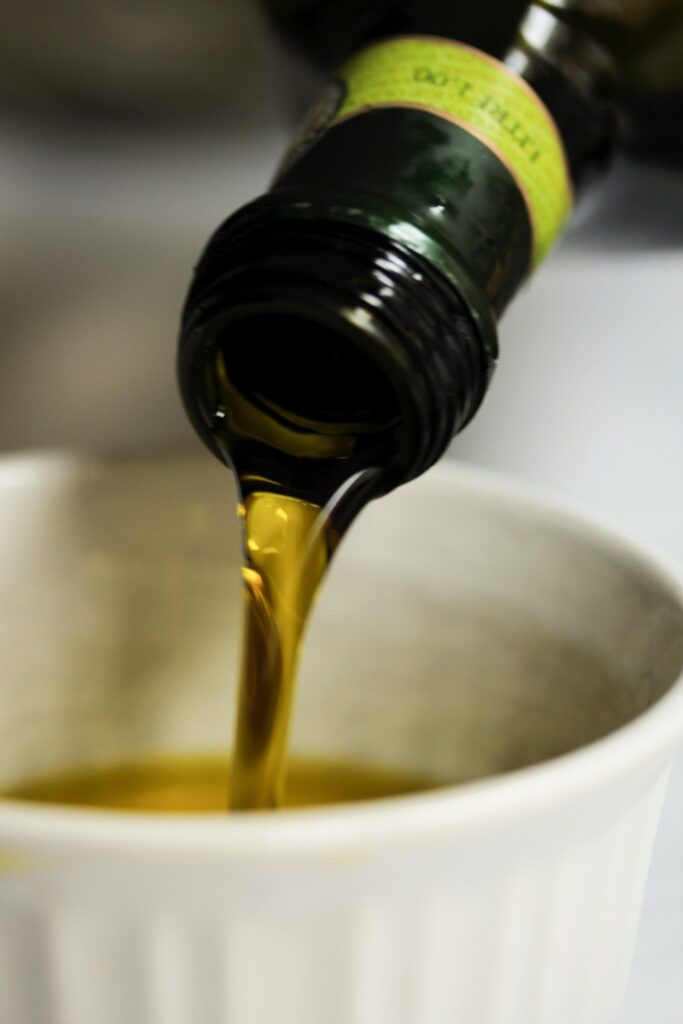
  8. Drizzle the olive oil evenly all over the baklawa.
  9. Cook the baklawa in the oven for about 25 to 30 minutes, until it has lightly browned. (Start checking after 15 minutes of baking).
  10. While the baklawa bakes, gradually add the rosewater to the honey, until the honey is properly fragranced. The potency of rosewater varies a lot from brand to brand, and also depends on freshness, so taste as you go. You should be able to distinctly taste the rose, but it should not taste soapy or perfumey.
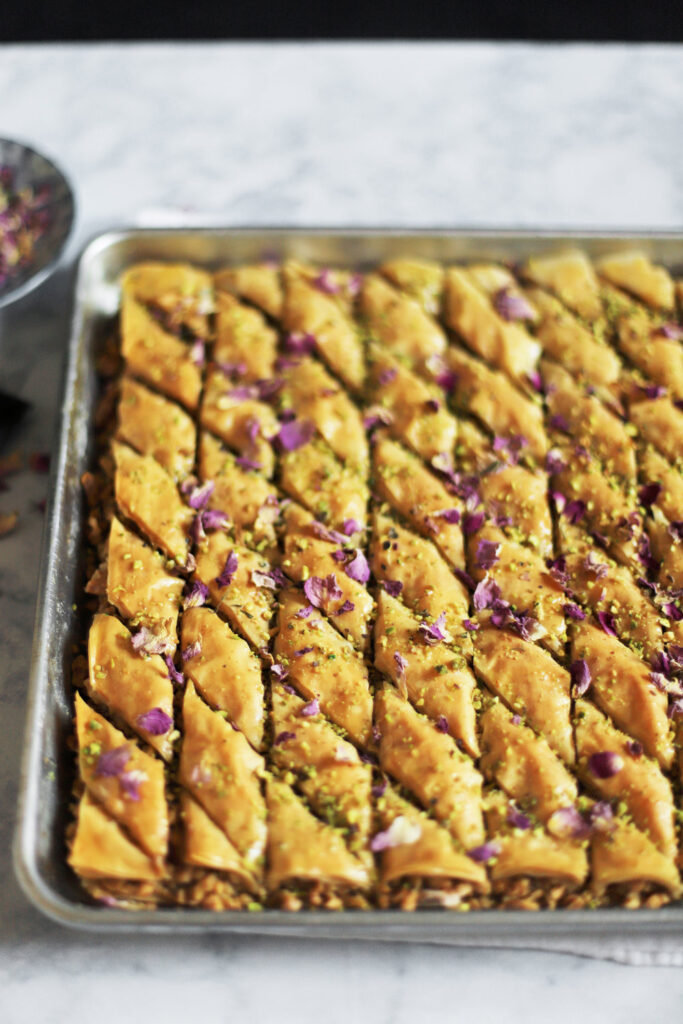
  11. Cool the baklawa at room temperature in the pan for about 5 to 10 minutes, until it’s still warm, but not radiating heat from the top. Once cooled to this point, immediately pour the rosewater honey evenly over the top.
  12. Immediately top with ground pistachios and rose petals.
  13. Let it sit until it comes to room temperature, at least one hour.
  14. Cut through the same lines you made before baking and serve. Store in the refrigerator for up to 1 week or the freezer for up to 3 months.

Notes

* You can find rosewater at Middle Eastern or Indian markets. You can also find it online (just make sure you find an edible one, rather than a cosmetic one). Different varieties vary in strength, so you should taste as you go.

** Dried edible rose petals can be found in most tea or spice shops, or online. Most of the rose flavor in this recipe comes from the rose water, but if you leave these out, just add a touch more rosewater to compensate.

Note: If you have any leftover baklawa, you can freeze it and turn it into baklawa frozen yogurt. In the frozen yogurt recipe, add about a teaspoon of rosewater to the yogurt and substitute cinnamon for half of the cardamom.

find us on instagram and let us know what you made!

Filed Under: dairy free, every recipe, sweets Tagged With: baking with olive oil, baklawa, honey, middle eastern, olive oil, pistachio, rosewater, spring

  • « Go to Previous Page
  • Page 1
  • Interim pages omitted …
  • Page 175
  • Page 176
  • Page 177
  • Page 178
  • Page 179
  • Interim pages omitted …
  • Page 183
  • Go to Next Page »

Primary Sidebar

Kathryn Pauline smiling

Welcome! I’m Kathryn Pauline, cookbook author, recipe developer, and photographer.

What’s new? 🥕

cauliflower frying

Fried Cauliflower

edible cookie dough

A Better Way to Make Edible Cookie Dough

steamed kale

Steamed Kale (without a steamer)

steamed cauliflower

Steamed Cauliflower

strawberry rhubarb jam in a jar with a spoon photographed from overhead

Strawberry Rhubarb Jam

rhubarb cookies

Rhubarb Cookies

Footer

read our privacy policy

© 2017 - 2026 Kathryn Pauline