• Skip to primary navigation
  • Skip to main content
  • Skip to primary sidebar
  • Skip to footer
Cardamom and Tea
  • Blog
  • Recipes
  • About
  • Cookbooks
    • Piecemeal
    • A Dish for All Seasons (my first cookbook)

Chocolate Oatmeal

April 2, 2026 by Kathryn Pauline Leave a Comment

chocolate oatmeal

This chocolate oatmeal is such a treat. And my particular recipe is super flexible. You can make it vegan, with whatever milk you prefer. You can change out the sweet cocoa topping for whatever sweetener you prefer. And you can make it either creamy or chewy.

After developing eight oatmeal recipes (and spending way too much time thinking about oats), I’m convinced the key to great oatmeal is customization. People have ridiculously specific preferences about their oats—more so than with most other foods. For some reason (I’m not sure why!), oats are deeply personal. And so is this recipe!

My hope is that you’ll be able to use this recipe to make the oatmeal of your dreams, whether creamy, chewy, or somewhere in between, with whatever sweetener you’d like, and with whatever ingredients you’ve got.

Jump to the recipe to hit the ground running, or read on for more details about how to create your perfect bowl.

chocolate oatmeal
chewy oatmeal
chocolate oatmeal
creamy oatmeal

Chewy vs. creamy oatmeal

This oatmeal recipe has you covered whether you prefer your chocolate oatmeal chewy or creamy. If you like it chewy, you’ll just add less liquid and simmer for less time. If you like it creamy, you’ll add more liquid and simmer it longer.

You might see the pairs of photos in this post and have an instant instinct about which you prefer. But if you don’t, here are some things to consider:

  • Do you generally like the recipe on the back of the box (team chewy), or do you find it disappointing (team creamy)?
  • Do you often like things with a silky smooth texture like butternut squash soup, polenta, and congee (team creamy), or are you someone who often dismisses certain foods as “too much like baby food” (team chewy)?
  • Are you always trying to recreate hotel breakfast bar oatmeal at home (team creamy), or does that sound more like unappealing cafeteria food to you (team chewy)?
  • Did you have trouble answering the above questions because you’re like “it depends!”? You might want to try both and see which one you prefer!

Here’s a video to help you decide (the oatmeal pictured in it is cinnamon oatmeal, but the same idea applies, and the recipe card at the end of this post has a separate video for this chocolate oatmeal recipe).

If you can’t get the above video to appear, please disable ad block and try reloading the page.

chocolate oatmeal
chewy oatmeal
chocolate oatmeal
creamy oatmeal

Adding sugar to chocolate oatmeal

The fact is, we absolutely must add some amount of sweet stuff to chocolate oatmeal for it to taste good. But there’s a lot you can adjust based on your own preferences and dietary needs:

1) High impact, less sugar

I am not a dietitian so I cannot tell you how much added sugar you should be consuming. But I am a professional recipe developer and cookbook author, and I can tell you precisely how to create the biggest impact with the least amount of an ingredient possible.

So here’s how to create the sweetest oatmeal with the least amount of sugar possible:

chocolate oatmeal with cocoa dusting on top

Sprinkle, don’t stir!

You absolutely can stir sugar into the oatmeal itself. But any sugar you stir in while it cooks will get a bit lost in the mix.

This is actually a very tasty direction to go, but it’s a lot more sugar for much less impact. Sprinkling sugar on top means you don’t have to use quite as much to get the same level of perceived sweetness.

Do with that information what you will!

  • If you are totally cool with any amount of added sugar, add some to the oatmeal while it cooks and sprinkle some on top.
  • If you’d like to use less added sugar, sprinkle it on top and don’t add any sugar while it cooks. The recipe in this post defaults to just sprinkling sugar on top.

2) The kind of sugar is up to you!

Refined sugars: The recipe in this post uses a combination of brown sugar and cocoa, perfect for dusting and creating melty dark chocolatey pools of syrup. You can also use plain old granulated sugar to the same effect.

Unrefined sugars: If refined sugar isn’t your thing, it’s also great with maple syrup drizzled on top. You can even mix the syrup with a little cocoa powder if you wish, but you don’t have to. However, I recommend against honey, which doesn’t have the right flavor profile.

Sugar-free alternatives: If you must avoid added sugar entirely, you can use Splenda or Stevia—just make sure you don’t overdo it. Remember that it is usually significantly sweeter than brown sugar per tablespoon. Read the package instructions and use a tiny amount of sweetener with a little cocoa powder thrown in. Dust on a small amount at first, and add more to taste.

Print

Chocolate Oatmeal

chocolate oatmeal
Print Recipe

5 Stars 4 Stars 3 Stars 2 Stars 1 Star

No reviews

  • Yield: 2 small chewy servings, 2 large creamy servings

Ingredients

for the oats:

  • ¾ cup old fashioned oats [75g]
  • 2 Tbsp cocoa powder
  • Between ¾ – 1½ cups water* [175g – 355g]
  • Between ¾ – 1½ cups your milk of choice* [180g – 360g]
  • ¼ teaspoon salt

for the sweet cocoa topping:

  • 2 Tbsp brown sugar
  • 2 tsp cocoa powder
  • A pinch of salt
  • Raspberries (optional)

Instructions

  1. For the oats: In a small saucepan, whisk together the oats and cocoa powder until the cocoa is lump-free. Add the water, milk, and salt, and bring to a simmer over medium heat, stirring every minute or so. Once it comes to a simmer, reduce the heat to medium-low and continue to simmer, stirring occasionally. With the larger amount of liquid, this will take about 15 minutes**, until the liquid thickens and the oatmeal softens. With the smaller amount of liquid, this will take about 4 to 5 minutes, until the oatmeal thickens significantly.
  2. Pour into bowls and let it cool off for a few minutes (it will thicken a little more after a couple minutes).
  3. For the sweet cocoa topping: Stir together the sugar, cocoa, and salt. Sprinkle over bowls of oatmeal at the table.

Notes

* If you are a fan of creamy oatmeal (see photos above the recipe), use the larger amount of both the water and milk.

If you are a fan of chewy oatmeal (see photos above the recipe), use the smaller amount of both water and milk.

Use whatever milk you’d like. I prefer using either soy milk or cow’s milk. In my experience, oat milk tends to be too starchy for making oatmeal. But any alternative milk will do.

** For the creamier, longer-simmering version, it will start out watery, and at a certain point it will noticeably thicken (e.g., the bubbles will get bigger), while still remaining very pourable and creamy. Leave it uncovered the whole time, and be careful not to let it bubble over. If you’re using a wide pan instead of a small saucepan, you may need to add a bit more water as it cooks (more water will evaporate from a wide pan).

Video note: If you don’t see the video for this post after scrolling up, please disable ad block and try reloading the page.

find us on instagram and let us know what you made!

Filed Under: breakfast, dairy free, every recipe, gluten free, vegan, vegetarian Tagged With: chocolate, oats, raspberry

Rhubarb Upside Down Cake

March 23, 2026 by Kathryn Pauline Leave a Comment

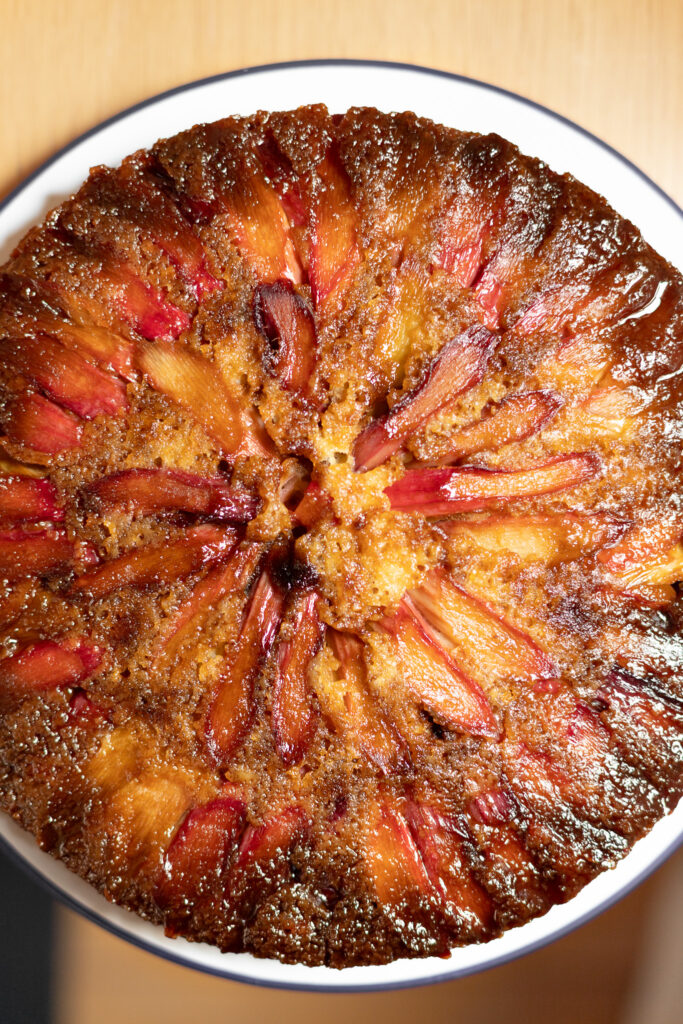
rhubarb upside down cake

This one-bowl rhubarb upside down cake has a butterscotch vibe without any actual caramel-making. Instead, you simply start out with brown sugar, which gives it a lovely caramel-ish flavor. The bottom of the pan gets coated in brown sugar, then rhubarb slices, then batter. The rhubarb and brown sugar become super syrupy, soaking slightly into the crust of the cake after inverting. We’re sacrificing some of rhubarb’s bright pink hue in favor of a deep, caramel flavor. And that’s a trade I’ll happily make any day!

Jump to the recipe to hit the ground running, or read on if you want to learn a little more about what makes this recipe unique.

rhubarb arranged at the bottom of a cake pan
cake in a pan

Rhubarb upside down cake specs

1. One-bowl!

My pet peeve is a one-bowl recipe that sacrifices quality for efficiency. But this recipe is not one of those. Instead of mixing the brown sugar topping in a separate bowl, my recipe has a helpful reminder not to wash that bowl. Instead, you should save it for making the batter. Who cares if there are a few bits of oil and brown sugar?

And instead of sifting your ingredients into a separate bowl, you will sift them right on top. The one caveat is to be very careful not to over-mix at this point. Adding the wet ingredients on top of the dry ingredients makes everything come together more easily. Adding the dry ingredients on top means you need to be more efficient with your mixing and stop as soon as there are no dry pockets of flour (even if it’s still a little lumpy).

2. Oil instead of butter = easier to store in the fridge

This recipe uses oil instead of butter, and that’s for a practical reason:

Ideally, baked goods are consumed the day they are made, but if you have to store one, the refrigerator is one of the worst places you could choose. Flour-based baked goods stale much more quickly in the cold environment of the fridge.

But with a fruit-based cake, you really need to store it in the fridge if you’re going to keep it longer than a few hours before enjoying. This creates quite the dilemma!

So to help fridge-proof it, we need to use oil instead of butter in the batter. Butter-based baked goods tend to stale more dramatically and more quickly when stored in the refrigerator. Using oil doesn’t mean we’re preventing staling completely, but it does buy us a day or two.

I’ve enjoyed this cake straight from the fridge the next day without any noticeable staling. If you notice it has staled slightly, you can always pop it in the microwave for 30 seconds or so.

rhubarb upside down cake

3. Super forgiving design

For this recipe, you really don’t need to arrange the rhubarb slices carefully across the pan. It’s a pretty rustic cake, so it looks great whether your slices are scattered or carefully arranged in concentric circles.

If you’re going to scatter them, I recommend slicing straight across into “C” shapes, which will nest together more easily into a single layer. That single layer specified in the recipe is very important—you don’t want any rhubarb pieces floating away and getting lost in the batter, and you want the rhubarb to cook through at the right rate. You just want one 1/2-inch layer of rhubarb pieces.

4. Can be made completely dairy-free

This recipe is already halfway to dairy-free, and you can absolutely get away with using an equal amount of unsweetened, plain soy milk in place of the cow’s milk. I’ve made it dairy-free many times using soy milk as a substitute.

I’ve never tried substituting vegan “eggs” in place of the chicken eggs, so if you want to make it totally plant-based, I can’t guarantee it would work. So I wouldn’t give that a try unless you are up for a risky experiment that may or may not work out (and if it doesn’t work out, you’ve been warned, so please don’t rate it 1 star 😇).

rhubarb upside down cake

Hope you enjoy this recipe! And if you’re looking for more ways to use up rhubarb, I’ve got a couple more.

Print

Rhubarb Upside Down Cake (one-bowl)

Print Recipe

5 Stars 4 Stars 3 Stars 2 Stars 1 Star

No reviews

Ingredients

  • ¼ cup [55g] neutral oil* or melted butter
  • ½ cup [100g] brown sugar
  • 4 to 6 rhubarb stalks [200g], cut into ½ in [13 mm] slices
  • 2 large eggs, at room temperature
  • ¼ cup [55 g] neutral oil
  • ¾ cup [150 g] granulated sugar
  • ½ cup [120 g] milk
  • 2 tsp vanilla extract
  • ½ tsp salt
  • 1½ cups [195 g] all-purpose flour
  • 1¼ tsp baking powder
  • Ice cream, custard, whipped cream, or yogurt for serving (optional)

Instructions

  1. Preheat the oven to 350°F [180°C]. Butter and line a 9-inch [23cm] round cake tin with a parchment round.
  2. In a medium mixing bowl, combine the oil or butter and brown sugar. Spoon that mixture over the bottom of the prepared pan. Do not wash the bowl. You will use it for the batter.
  3. Arrange the rhubarb slices evenly over the brown sugar mixture. They should sit in one even layer—if you have too much for 1 layer, do not use the extra.
  4. Place the eggs, second addition of oil, sugar, milk, vanilla, and salt in the mixing bowl. Stir together until completely combined.
  5. Place a fine mesh sieve over the batter, being careful not to get the sieve wet. Place the flour and baking powder in the sieve and dust over the wet ingredients to sift.
  6. Stir together the wet and dry ingredients, being very careful not to overmix. Pour the batter over the rhubarb layer in the pan and smooth out the top.
  7. Bake for 35 to 40 minutes, until a toothpick comes out clean.
  8. Let it cool for 10 minutes in the cake pan, then trace around the edge and invert onto a plate (ideally one with a lip in case there is a lot of syrup). Cool for at least 30 more minutes before slicing and serving.

Notes

* e.g., canola, light olive oil, etc.

Video note: If you don’t see the video for this post after scrolling up, please disable ad block and try reloading the page.

find us on instagram and let us know what you made!

Filed Under: dairy free, every recipe, sweets Tagged With: cakes, rhubarb, spring

  • « Go to Previous Page
  • Page 1
  • Interim pages omitted …
  • Page 4
  • Page 5
  • Page 6
  • Page 7
  • Page 8
  • Interim pages omitted …
  • Page 183
  • Go to Next Page »

Primary Sidebar

Kathryn Pauline smiling

Welcome! I’m Kathryn Pauline, cookbook author, recipe developer, and photographer.

Footer

read our privacy policy

© 2017 - 2026 Kathryn Pauline