
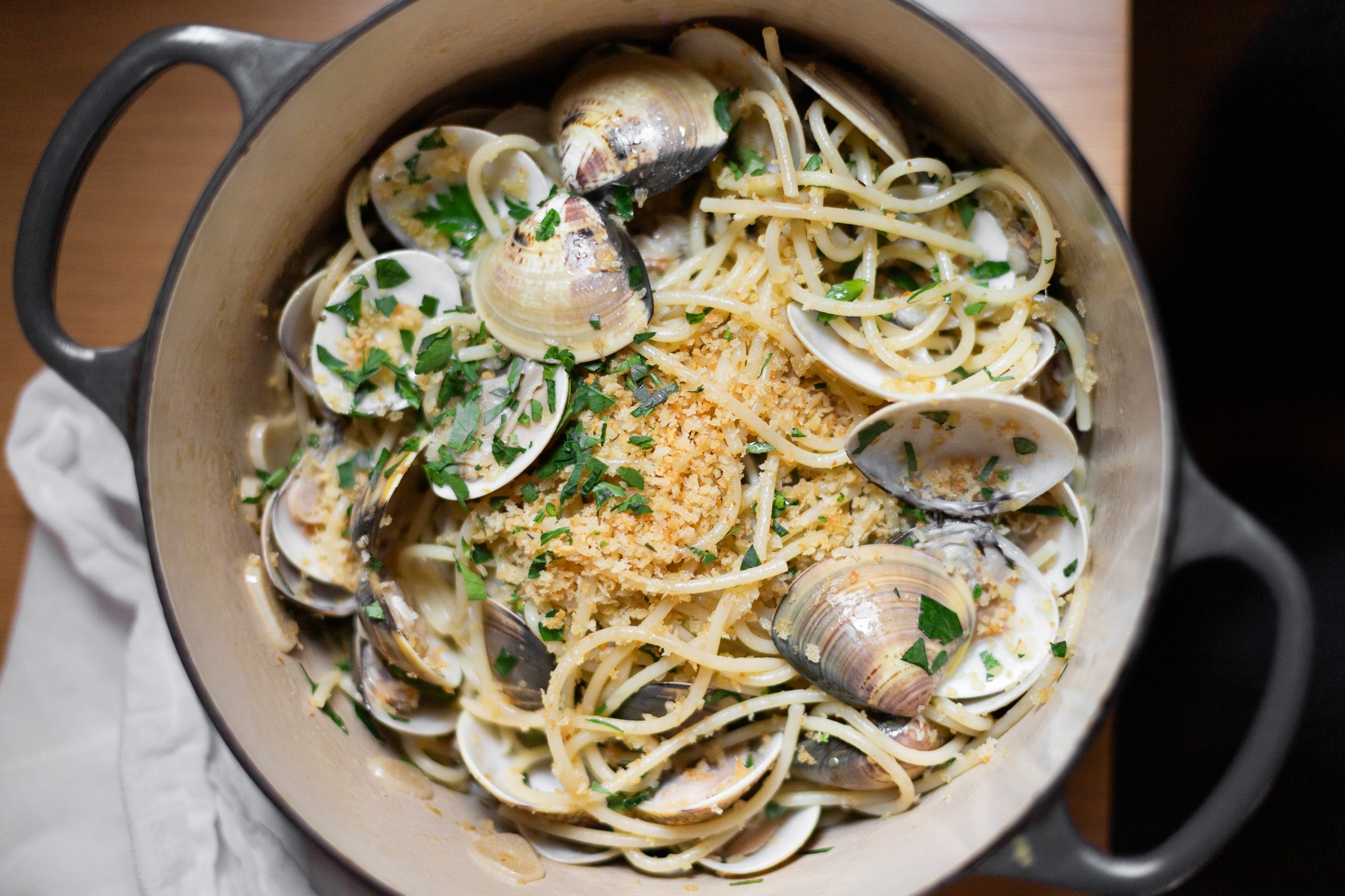
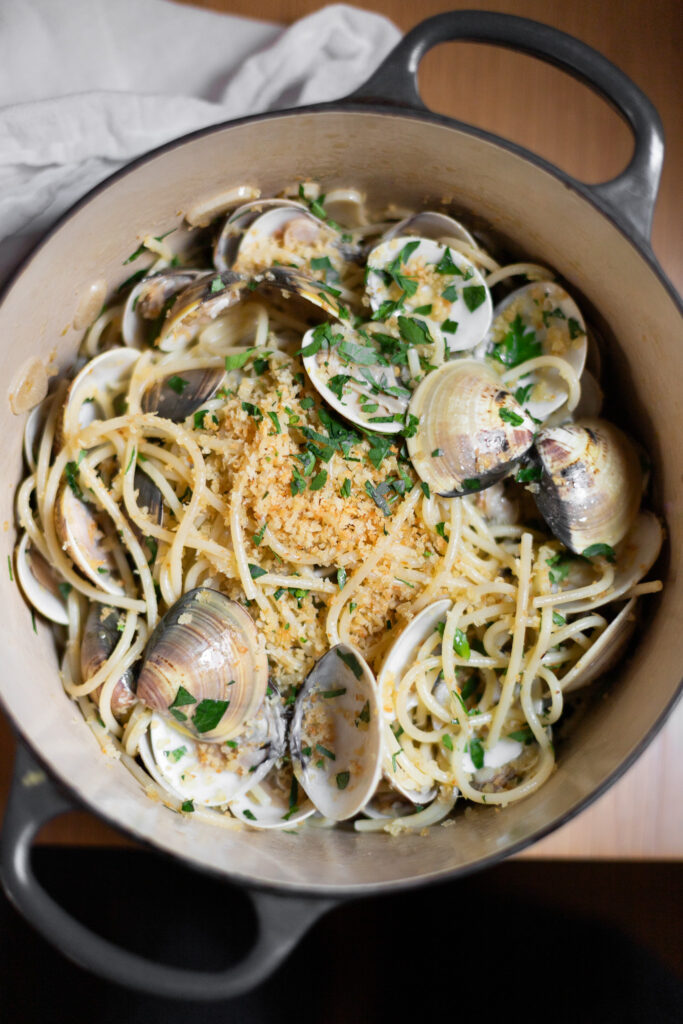
For the last 7 years, this spaghetti alle vongole recipe has existed as a 14-line recipe in my phone’s notes app. Any version of pasta with clams is a desert-island-dish for me, and this is the most delicious, easiest way to make it. Truth be told, I’ve always been a bit disappointed by the results of other vongole recipes I’ve tried, so I decided to officially write up, test, and share my tried-and-true one.
What’s my beef with most spaghetti alle vongole recipes? Not to be a negative Nancy, but:
- Nearly all clam recipes make you throw away a whole bunch of perfectly good, 100% alive clams because of a common misconception about how to cook them. This recipe does not do that. More on that soon.
- Most recipes for spaghetti with clams do not have you do a proper white wine reduction, which is the only way to get the right flavor.
- A few vongole recipes over-complicate things and make you use a million different pots and pans. This recipe just uses 2 pots (one for the pasta, one for everything else) and does everything it can to streamline the process.
- Most recipes do not account for the existence of super-salty clams, which can absolutely ruin a dish. But whether your clams have a normal amount of sodium or a bonkers amount, this recipe has you covered.
Jump to the recipe to start cooking, or read on to learn more about what makes this recipe easy (and also special).
What makes this recipe super flavorful:
The biggest risk with spaghetti alle vongole is blandness. I mean, it’s basically just clams and pasta, which is not the most thrilling starting point. But when it comes to flavor, this recipe has you covered:
1. Garlic, garlic, garlic! (and toasted breadcrumbs)
Garlic is the primary seasoning. Here it shows up in both the breadcrumbs and the white wine sauce via 9 whole cloves.
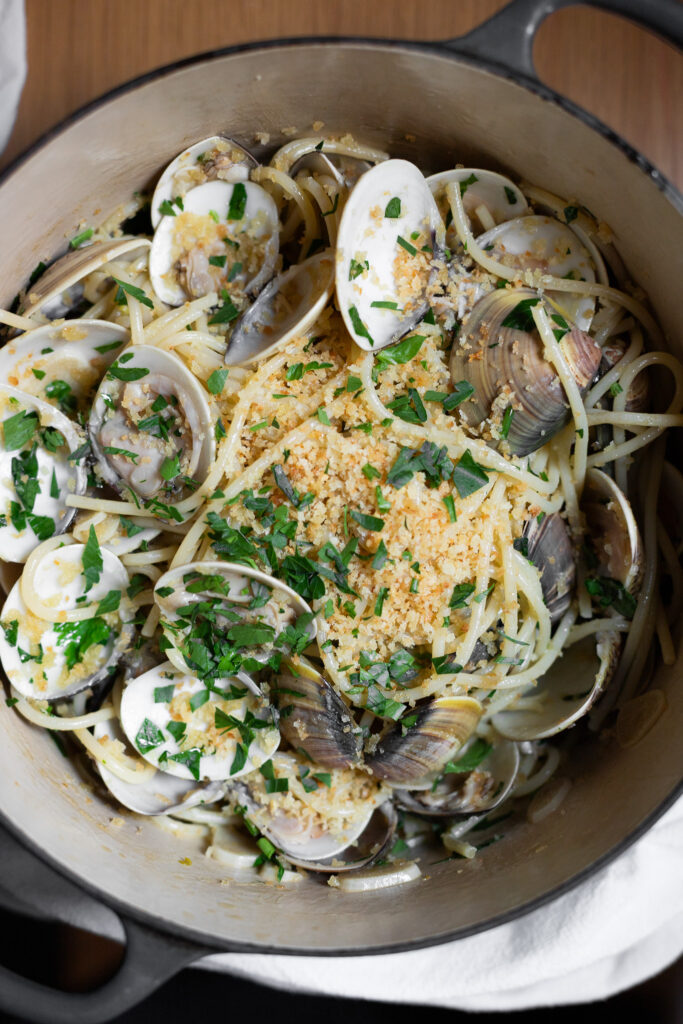
The toasted breadcrumbs also add a crisp and roasted flavor that would otherwise be missing from a whole lot of (let’s face it!) mushy ingredients. Furthermore, those breadcrumbs help the white wine sauce cling to the pasta. That means that every bite is packed with flavor.
2. White wine reduction
Most recipes do not call for enough wine to achieve a true reduction. To get the right flavor and texture, it needs to reduce down quite a lot. That means you need to start with a larger amount of wine to end up with the right amount in the end.
My recipe calls for about half a bottle, which reduces down into a super flavorful sauce (once before the clams go in, and again after they cook and release their “clam liquor”). The reduction process goes much more quickly than you’d think, especially if your pot is not super narrow.
I’ve seen some recipes that do not have you reduce the cooking liquid after cooking the clams. In my experience, that leads to a soupy mess. Clam liquor itself is not a sufficient pasta sauce. And I’ve also seen recipes that have you reduce the liquid with the clams still in the pot, which almost certainly results in overcooked clams.
The key to a good spaghetti alle vongole: reduce, reduce, reduce! (Just get those clams out of there first!)
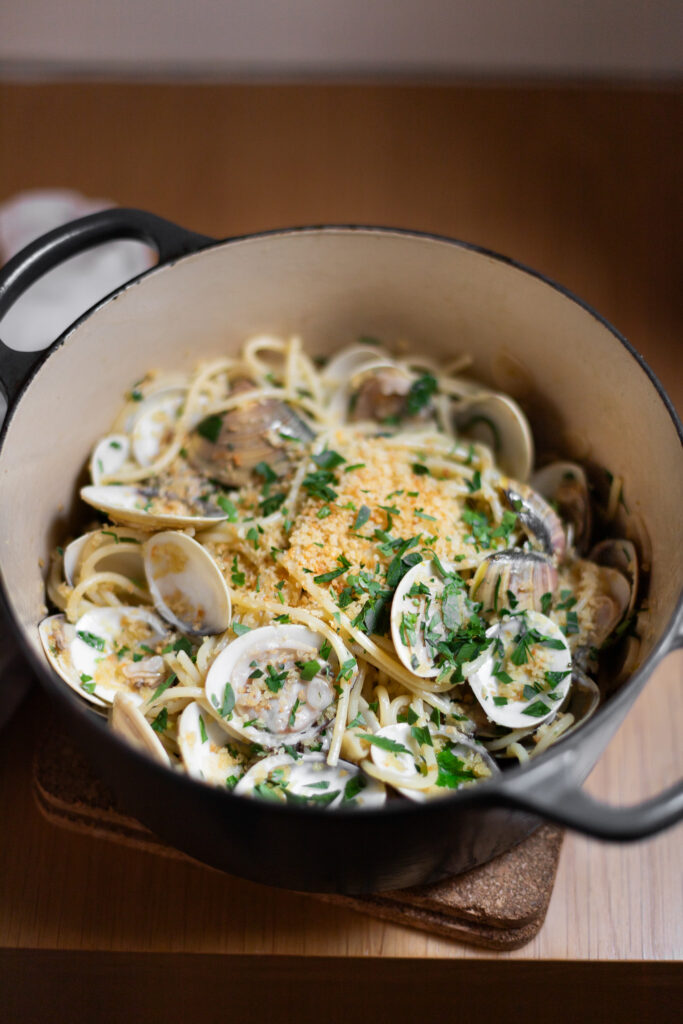
What makes this recipe efficient and fool-proof:
Spaghetti alle vongole is easy to over-complicate. It’s also easy to get wrong in a few key ways. This recipe keeps things streamlined, and it also gives you the tools you’ll need to handle a few potential pitfalls.
1. You have full control over the saltiness.
All clams give off a different amount of saltiness. I live right by a fish market where you can buy clams that were happily burrowed in the sand just a few hours ago. I’ve also used clams from the supermarket (you know, the ones that come in those vacuum-sealed bags). My fish market clams give off an absurd amount of salt, even after purging. The clams from my supermarket don’t give off nearly as much.
This means you have to taste the sauce and adjust. Normally, reducing the amount of salt in a dish is impossible after the fact, but this recipe includes tricks for both over-salted and under-salted clams:
If your clams don’t give off much salt, you can add a bit of your own (duh). And if they give off too much salt, you just scoop out a bit of the clam liquor, discard it, add some more wine to compensate, and reduce down from there.
2. Just two pots.
It’s hard to get spaghetti alle vongole down to just 1 pot, since it’s most efficient to cook the pasta at the same time as the sauce. But this recipe does get it down to just 2 pots. You toast the breadcrumbs, and then reuse the same pot for the clams without washing it. Many other recipes have you jumping back and forth from one pot to another, using a separate one for the clams, the sauce, the pasta, etc. I’ve tried to streamline that as much as possible because I hate doing dishes as much as the next home cook.
3. No wasting perfectly good clams.
Most recipes don’t quite get the process of cooking live clams, which leads to wasting perfectly good shellfish.
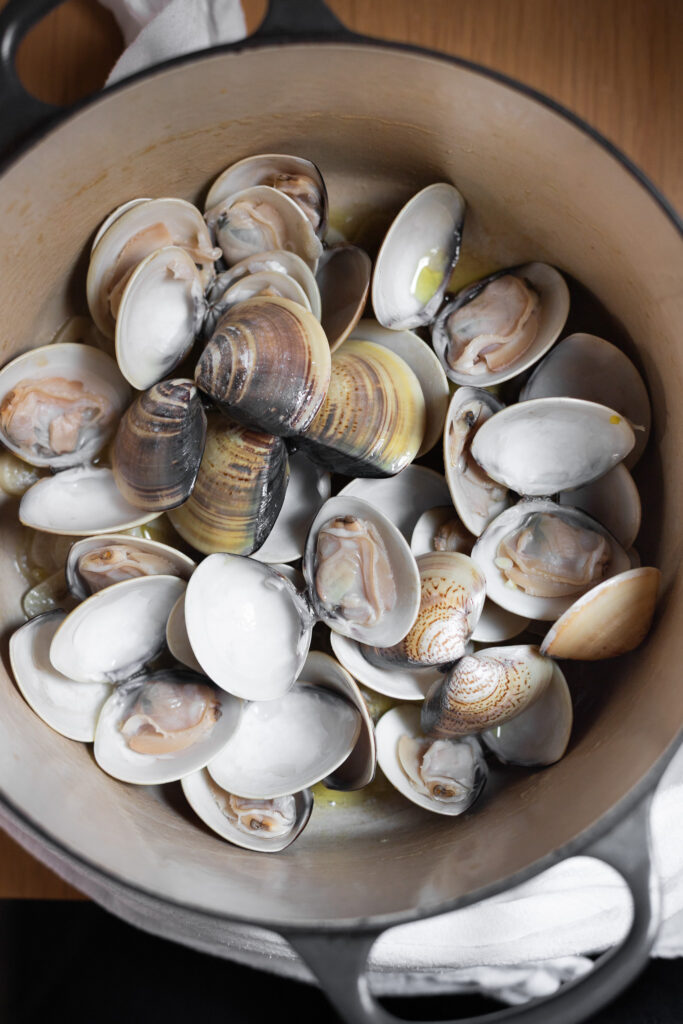
The most essential step is to throw away any cracked, chipped, or unresponsive clams before cooking. If an uncooked clam is flopped open and doesn’t close when you disturb it, it is dead. If any clams are cracked or chipped, you should assume they are dead. A tightly closed, completely intact clam is most likely a live clam.
Once you cook them, most of the clams will open after about 5 minutes, but a few might stay closed. This is where most recipes would tell you to throw them away. But you can actually test to see whether they are indeed dead. Remove the open ones, and give the closed ones a couple more minutes to cook. If they open after a couple more minutes, then they simply needed a little more time. If they stay closed, then you should discard them. Those clams were (spoiler alert!) dead all along!

Spaghetti alle Vongole (the easiest ever)


Ingredients
For the topping:
- 1 Tbsp extra virgin olive oil
- 2 medium cloves of garlic, crushed through a press
- 2/3 cup [50 g] panko breadcrumbs
- 1/2 cup [20 g] chopped parsley
For the clams:
- 7 cloves of garlic, sliced thinly
- 1 1/2 cups [350 g] dry white wine (about half a bottle*)
- 2 lb [905 g] fresh, live clams, purged**
- 1/4 cup [60 g] extra virgin olive oil
For the pasta:
- Boiling water
- 10 oz [285 g] spaghetti (or another long pasta)
Instructions
- Place the olive oil and crushed garlic in a medium stockpot or dutch oven and set over medium heat. Once the garlic starts quietly sizzling, add the breadcrumbs and stir everything together. Stir constantly until the breadcrumbs turn golden brown (about 5 minutes).
- Once the bread crumbs have toasted, remove to a bowl. Place the parsley in another bowl. Do not wash the pot.
- Set the pot back over high heat. Add the sliced garlic and white wine. Bring to a boil and let it boil for about 10 minutes, until it’s reduced to just about 1/2 cup and thickens slightly.
- In the meantime, bring a large pot of water to a boil. Don’t salt it.
- Add the clams to the wine reduction. Cook for 5 minutes over medium-high heat, just until most of the clams open. Remove opened ones with a slotted spoon to a large bowl, leaving behind any closed ones. Cook the closed ones*** for another 2 minutes. Throw out any ones that never open and keep the newly opened ones.
- Raise the wine/clam liquor to high heat. Taste and see note if it is extremely salty.**** Let it reduce down for about 5 minutes. It should once again thicken and reduce down to about 3/4 cup.
- While you’re waiting for the sauce to reduce, place your pasta in the boiling water and cook to al dente according to the package instructions. Once done, drain and do not rinse (toss in a little olive oil if the sauce is not done).
- Taste the sauce again and adjust seasoning. It should taste salty but not too salty. Once you’re happy with the sauce, add the olive oil, clams, and pasta and remove from heat.
- Add half the breadcrumbs and half the parsley to the pot with the clams and pasta. Toss together. Move to a serving bowl, top with more breadcrumbs and parsley, and enjoy.
Notes
* This is not time to break out a pricey bottle. Use whatever inexpensive wine tastes pretty good to you. You shouldn’t wince when you take a sip, but you don’t need to want to take another.
** Purging means letting your clams sit in salty water for an hour or so and then lifting them out. You should also sort through your clams and discard any dead ones (those are flopped open and/or broken). Here’s a great guide to purging.
*** It’s a common misconception that closed clams are necessarily dead. Once cooked, clams release and flop open. Closed clams usually just need another couple minutes of steaming with the lid on. However, if they don’t open even after a few more minutes of cooking, throw those away. Never eat a clam that does not open after steaming.
**** If it is too salty, don’t despair. Remove some of the liquid (remove a lot if it’s extremely salty). Add some white wine to replace the amount lost, and reduce from there. Clams range a lot in their saltiness. I’ve needed this trick a few times, but I’ve also had times where I did not need to use it. It really depends!
Video note: If you don’t see the video for this post after scrolling up, please disable ad block and try reloading the page.
Leave a Reply