

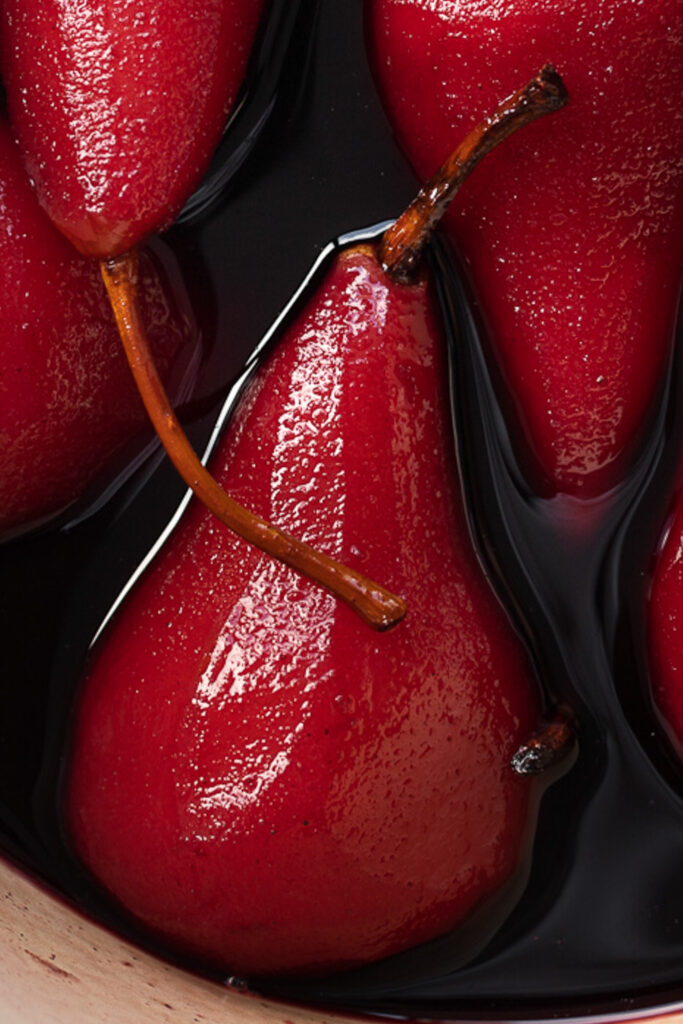
Conventional wisdom says that you should never cook with a wine you wouldn’t drink. But these mulled wine poached pears are so beautifully spiced, they don’t need a fancy bottle. They don’t even need a $10 bottle. Grab the most below-average red you can find! By the time they’re done poaching, you’ll have a deeply fragrant syrup that tastes far more luxurious than it has any right to.
Jump to the recipe to hit the ground running, or read on for some tips for success + ways to use these poached pears once you have them.

Tips for poached pear success
1. Simmer, don’t boil.
As soon as the liquid bubbles, ease the heat down. You want a very lazy simmer, not a rolling boil that turns your elegant pears into applesauce.
2. Choose the right ripeness.
Go for semi-ripe Bosc pears—they should feel firm but not rock-hard, and definitely not soft, and they should taste good raw. They will be perfect about 1-2 days after bringing them home rock-hard from the supermarket. Here is a guide to pear ripeness.
3. Don’t skip the mulled wine reduction.
Just remove the poached pears first, once they’ve reached your desired doneness. The reduction will make your whole house smell like Christmas, and you can use the resulting syrup in baked goods and snacks. Speaking of which…


Ways to use poached pears
- On puff pastry tartlets
- Baked into a spiced chocolate pear cake
- With a little ricotta, mulled wine syrup, and pistachio
- Slice and toss into a spinach salad
- On oatmeal
- Sliced and served on a charcuterie board with blue cheese, prosciutto, and pecans
- Serve a hot poached pear with a scoop of ice cream, a drizzle of syrup, and cookie crumbles
Poached Pears

- Yield: 7 pears
Ingredients
- 7 semi-ripe firm Bosc pears*
- 1 bottle [750 ml] red wine**
- 1 cup [200 g] sugar
- 1 scraped vanilla pod or 2 tsp vanilla bean paste
- ½ tsp ground cinnamon
- 1 whole star anise pod (optional)
- 5 cardamom pods (optional)
Instructions
- Use a zucchini corer or a small melon baller to drill into each pear from the bottom, scooping out the seeds and any stony bits. After coring, peel the pears.
- Place the pears in a small saucepan and add the wine, sugar, vanilla, cinnamon, star anise, if using, and cardamom, if using. Bring to a simmer, uncovered, over medium heat, keeping a very close eye on it. As soon as bubbles begin to break the surface, gradually lower the heat to low to maintain a bare simmer. Do not let it boil or your pears will turn to mush; tiny bubbles should break to the surface around the pears, almost like effervescence.
- Simmer, uncovered, for about 30 minutes. Gently rotate the pears a couple times to make sure they’re cooking evenly. They are done once you can easily insert a paring knife into the pear while still feeling a little resistance.
- Transfer the pears with a slotted spoon to a container that snugly fits them.
- Bring the poaching liquid back to a simmer over medium-high heat. Let it reduce down to ⅓ to ½ its original volume (to 1¼ to 1½ cups [350 to 425 g]; it takes about 20 minutes, but varies a lot based on the width of your pan). Pour the liquid over the pears and refrigerate until ready to use.
Notes
*Semi-ripe firm pears are pears that have sat at room temperature for 1 to 2 days after bringing them home rock-hard from the supermarket. They shouldn’t have much give, but should be a little juicy when you cut into one.
** Do not shell out for an expensive bottle. It’s getting drowned in sugar and spices and will taste great with anything that’s not total vinegar.
Storage: Use any pears floating above the surface within the first day or 2, then keep the fully submerged pears for up to 5 days. Or slice in half, submerge in syrup, and freeze in a tightly sealed container. Pears can be kept this way for at least 3 months with no loss of quality.

Psst… by the way, I love this recipe so much, I ended up including it in my cookbook, Piecemeal.
If you like this recipe as much as I do, you might like my book! It’s full of mix-and-match recipes and inspiration for fun and easy meals. There are recipes in it for pears with mascarpone and streusel, tartlets, and loaf cake that all use these poached pears as their base.
Leave a Reply