
Since 2017, I’ve developed over 500 recipes for my blog and cookbooks. From the beginning, I’ve aimed for accuracy and precision. By 2020, I got it down to a science. Here is what I’ve been doing since then to ensure that my recipes are reliable and accurate:
1. Measurement
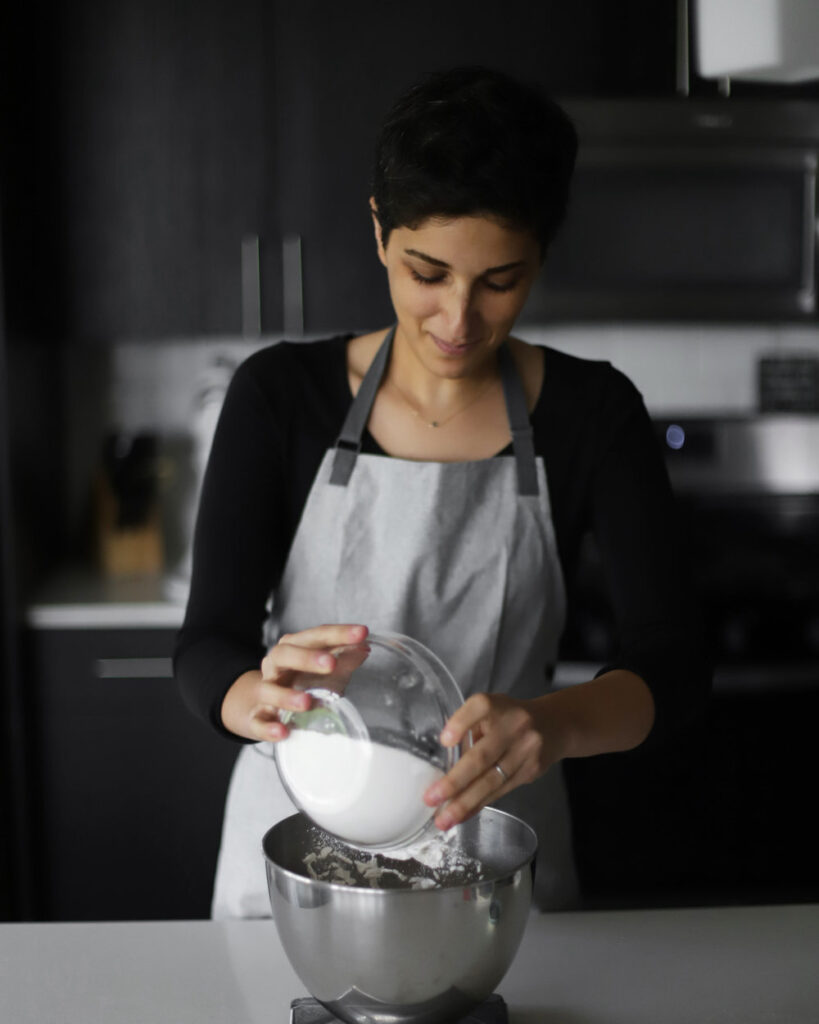
I test exclusively with weight (even if the final recipe primarily uses volume).
This sounds counterintuitive, I know! But testing with weight produces a more accurate recipe, regardless of how readers eventually choose to measure. The reasoning is simple: volume is an estimation, while weight is not. For recipe testing, we need consistency. That means that volume is the enemy.
For cooking from a finished recipe, volume is totally fine. You’re not trying to engineer something that works for thousands of home cooks. That’s my job! And as long as I’ve done my job, your recipe will turn out even if you reach for those less-accurate measuring cups.
An illustration of why volume is bad for recipe testing:
- Let’s say I’m developing a blueberry galette and my recipe calls for “1 cup of frozen blueberries.” The actual amount of blueberries in a cup varies wildly depending on berry size, how I level off the cup, whether they’re freezer-burned, and whether they’ve already started thawing in a very warm kitchen.
- If I test the recipe 3 times by volume, I might use a different quantity of blueberries each time. The galette might set perfectly once and then get all runny the next—and I would have no clue why. Weight eliminates that ambiguity. In round 2, I can reduce the berries or up the cornstarch and know exactly what changed.
Why this makes volume measurements better for you, a home cook:
The cool thing is that because I’m testing in weight, the volume conversions I publish are more accurate than recipes tested in volume from the start.
Most conversion charts online rely on estimates and vibes with a few accurate data points sprinkled in. King Arthur’s is the best I’ve found, but even that one has several inaccuracies. Mine is built from measurements I’ve actually weighed.
Here are 2 examples (1 success and 1 disaster):
- Testing with weight: Let’s say I call for “1 cup (130g) frozen blueberries.” An under-scooper uses 110-120g; their galette is very slightly runnier than mine, but it’s totally fine. An over-scooper uses 140-150g; theirs sets a little more than mine but it’s also fine. Unless someone is going wild with the measuring cup, everyone lands close enough.
- Testing with volume: I call for “1 cup frozen blueberries” and measure without weighing. It’s a hot day, and my berries are softening and mushing together, so I unknowingly pack 150g into that 1 cup. A reader that slightly under-scoops will only use 110g. But the successful test run used 1.4x that amount! Their galette will turn out very stodgy and gluey.
Most (not all!) recipe developers test in volume and then convert it into weight, and this is very frustrating.
- Including a weight measurement implies accuracy and precision. If I list a measurement in grams, you can be darn sure I actually weighed those ingredients. Unfortunately, this is not true of all recipes.
- While it’s fine to convert from weight to volume, it’s kind of useless to test in volume and then convert into weight. Cups and grams are not just two equally reliable systems that can be freely converted between. You lose information by converting from weight to volume, which is okay. We can deal with losing some information. But when you convert from volume into weight, you introduce noise and new inaccurate information. And that’s not good! Less information is fine—wrong information is unacceptable.
- If you want to find reliable recipes, my advice is to find food blogs that actually test their recipes in weight. Or find a blog that uses volumetric measurements with a lot of useful cues and tips. There is a whole other school of thought that empowers cooks to be able to eyeball quantities on their own and judge for themselves. I borrow a lot from this other school of thought and try to do both as much as possible.
2. Temperature
- I calibrate my oven with a free-standing thermometer, I use instant-read and candy thermometers when applicable, and I include temperature as a doneness indicator whenever I can.
- That said, many home cooks don’t own a single thermometer. I do recommend stocking up (they’re so useful!), but I also try to give as many sensory cues as possible: what to look for, smell, listen for, and feel. Timings are only estimates, while sensory cues will carry you much further if you’re cooking without a thermometer.
3. Method
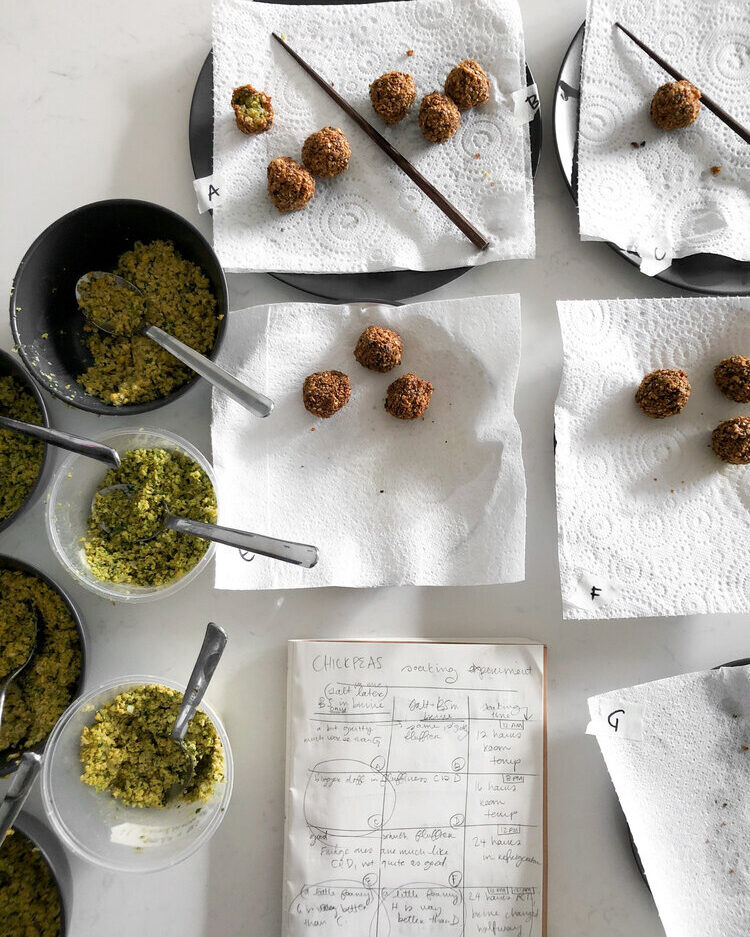
- Rather than describing exactly what I did in the kitchen, I usually write down what I intend to do, and then edit as I go. At this point in my career, I can usually write down a detailed recipe and have it be about 90% right on the first try. The other 10% is adjustments—a little more or less of an ingredient, a tweak to the method—which I record as I make them, and then verify with another test run.
- If I wrote it down and put it in a recipe, it means I did those steps in order exactly. When I cook for fun, I barely glance at a recipe. But when I’m testing for the blog or a cookbook, I follow every step I’ve written to the letter. If I find myself wanting to deviate, I change the step itself.
4. Photos and video
- My goal is for photos and videos to accurately represent what the recipe actually looks like.
- I don’t lean on heavy retouching. Sometimes I edit out grease stains on my stove because I was too lazy to clean. Sometimes I have the misfortune of slicing through a banana bread loaf right where I stabbed it with a skewer to check doneness—I’ll photoshop that line out. There are these 3 ugly plugs on the wall behind where I do a lot of shooting—I edit those out in Lightroom. Nothing more dramatic than that.
- I tend to shoot dark (side-lit with diffused natural light) and then brighten in post, and I usually remove a little blue and cyan (a lighting issue, not a food issue—IMO a bluish cast makes good food look really dead and unappetizing). My goal is always to get closer to how the food looked in real life, not further from it. Anything I do to the lighting and color balance is to preserve that.
- I don’t use food styling stunts. Maple syrup is made from maple syrup, not motor oil. Ice cream is ice cream, not shortening. I don’t pile on extra toppings for the camera—what’s in the photo is what’s in the recipe. The wildest food styling thing I’ll do is skewer a sandwich for a clean straight-on shot, then photoshop the skewer out afterward.
- When I can, I share approachable styling tips in the instructions themselves. In my Persian love cake recipe, for example, I explain how to get the drizzled icing and sprinkled rose petals just right.
5. Things I don’t do
- I am not a dietitian or a doctor, so I don’t give advice on health and diet. Relatedly, I also don’t include nutrition information.
- I don’t repost other people’s recipes without adapting them to become my own (and then profusely crediting the original).
- When readers ask if they can substitute an ingredient, I won’t say yes unless I’ve tried it myself. But I do try to give them a percentage chance. Like, “can I use chia eggs in this cheese souffle?” That’s a close to 0% chance of working out—I recommend against it. But “can I use a chia egg in this banana bread?” While I haven’t tried it myself, I think there’s like a 80% chance it will work great. If you’re up for a 20% chance of being terribly disappointed, I say go for it.