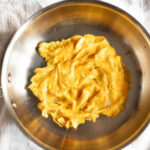
Scrambled Eggs in Stainless Steel
Be sure to read the whole post above this recipe card before cooking!
(This is the one and only time I’ve ever started a recipe card with a note like this one, so you know I’m serious 🫡)
Ingredients
- Extra virgin olive oil
- 2 to 3 beaten eggs*
- Salt
Instructions
- Dial your burner to its sweet spot** and place a 9.5 inch [24 cm] stainless steel skillet to preheat. It’s done heating once water drops dance across the surface of the pan (over medium-low heat that will be about 7 minutes for gas, 3 minutes for induction, or 10 for electric).
- Once your pan has preheated, add a glug of oil and use tongs to sweep the oil around the pan with a paper towel until it’s very evenly coated in a thin layer.
- Crank the heat to high, add a small, even drizzle of oil, and immediately add the eggs. Be careful not to pour them in one spot on the pan, but pour in a circular motion to hit the pan evenly.
- Once your eggs have started to form curds (about 10 to 15 seconds), use a fork or chopsticks to scramble them (do not use a silicone spatula). Season to taste.*** Let them sit for another 5 to 10 seconds, agitate them again, and repeat until they are done.
Doneness times:
- Very runny eggs: Total of 30 seconds on just one side (do not flip)
- Set eggs, which are still a bit custardy: 40 seconds on the first side, flip and cook for 5 more seconds on the other side.
- Well-done eggs: 45 seconds on the first side, flip and let cook for another 15 seconds (or longer).
If you leave the eggs in the pan, they will continue cooking, so remove from the pan as soon as they reach your desired doneness.
Notes
* Cooking too much egg at once will cool the pan and everything will stick. If you want to make more than 3 eggs, it’s very easy to work in batches. As long as they don’t stick, you won’t need to wash or re-heat the pan between batches, and it should breeze by very quickly. But do not try to add more than 3 eggs to the pan.
** I describe how to find your burner’s “sweet spot” above the recipe, earlier in this post. It is the medium-low temperature where you can maintain water-drops-dancing without the pan overheating.
*** Scientifically speaking, it doesn’t actually matter when you salt your eggs, but I prefer salting eggs at this point in the process. It’s less about texture and more about taste. But you can salt them whenever you prefer.